
Originally published by EarthSky.

2024 will be the year of the sun. Experts are predicting the peak of the sun’s 11-year cycle of activity for 2024. Plus, for us in North America, a total solar eclipse will take place on April 8, 2024. Learn more about it and some of the other best sky scenes of 2024, below. Fred Espenak shot the images for this composite of a total solar eclipse in Jalu, Libya, on March 29, 2016. The USPS used this image to create a postage stamp! Image via Fred Espenak/ Astropixels.
Best sky scenes of 2024
Mark your calendars for the best stargazing events for 2024. From planetary pairings to a solar eclipse, from meteors to a possible spectacular comet, and from star clusters to star-forming nebulae … here they are.
Remember, for a precise view from your location, visit the free online planetarium Stellarium. Enter your location and the date of the event to see a replica of the sky where you live.
January 8 and 9: Venus and friends
The thin crescent moon will be near the red star Antares – the brightest star in Scorpius the Scorpion – on the morning of January 8. Venus is the brilliant point of light nearby, and the much dimmer Mercury will pop above the southeastern horizon before the sun rises. On the following morning, the moon hovers just above the horizon and close to Mercury. Chart by John Jardine Goss/ EarthSky.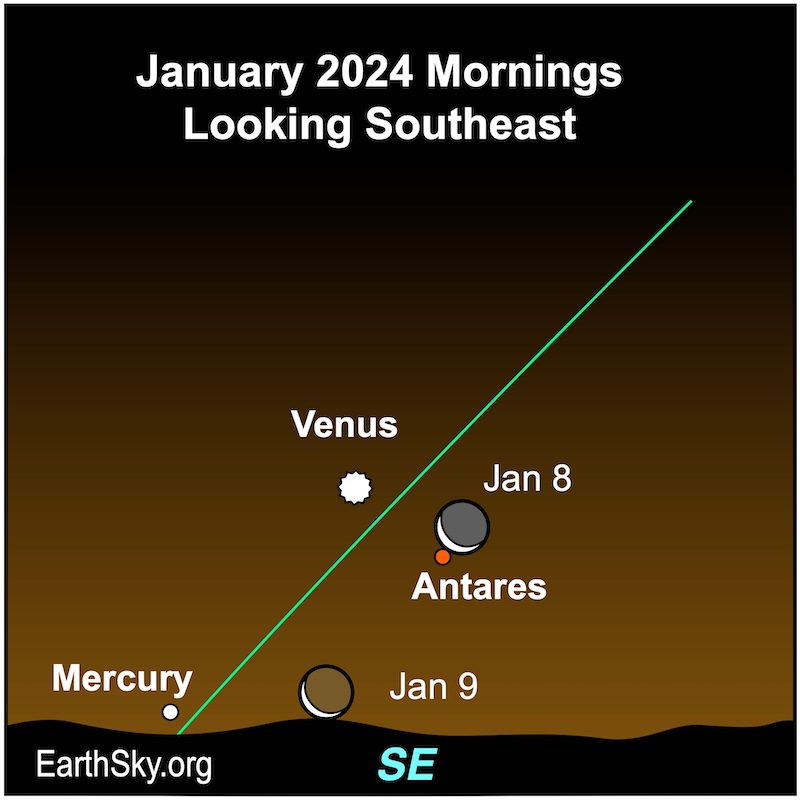
On the morning of January 8 and 9, look to the southeast for a crowded celestial scene. On the first morning, the thin crescent moon, full with earthshine, glows next to the bright red star Antares in Scorpius. Also, for skywatchers in the southwestern US, the moon passes in front of – or occults – Antares about an hour before sunrise. For everyone in the U.S., Venus brilliantly shines to their upper left. Then, 30 minutes before sunrise, little Mercury pops above the horizon, appearing to the lower left of Venus.
Later, on the following morning, an even thinner crescent moon floats below unmistakable Venus while Mercury rises a little higher than the morning before and appears next to the moon.
March 22 to 25: Mercury makes a grand appearance
Between March 22 and 25, Mercury makes a grand appearance in the western sky shortly after sunset. Chart by John Jardine Goss/ EarthSky.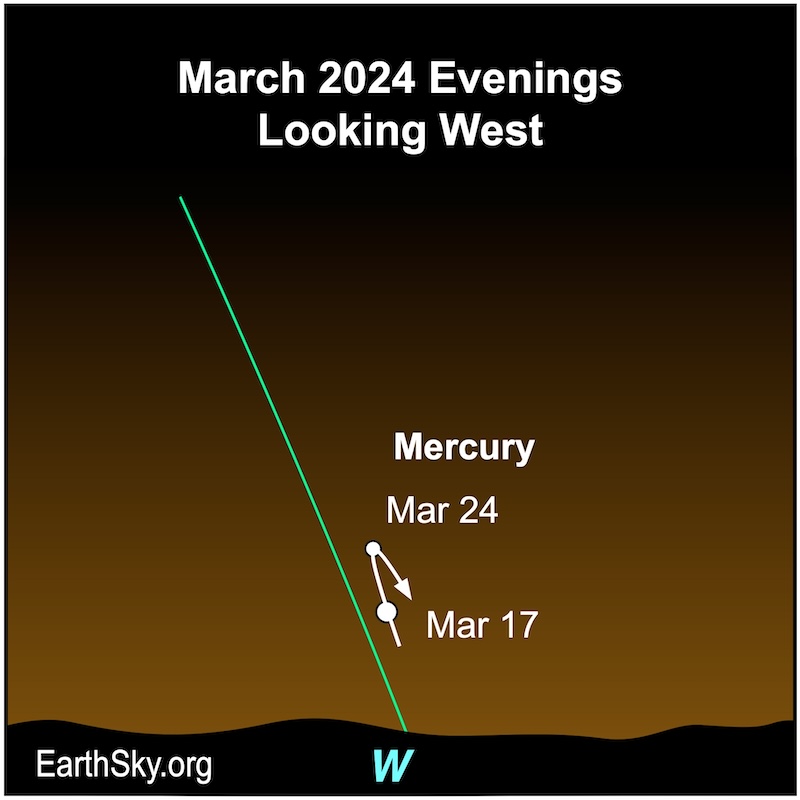
Mercury always lies close to the sun. Consequently, it never appears far above either the morning or evening twilight. From March 17 through March 25, as it nears eastern elongation, the little and sometimes elusive planet shines brightly in the western twilight 40 minutes after sunset. In a clear sky, you should be able to spot it easily.
April 8: A total (and partial) solar eclipse in North America
In the afternoon of April 8, the moon slides in front of the sun giving a solar eclipse. A partial eclipse occurs for the entire US, but along a very specific swath, a total eclipse takes place. Always use proper filters when directly viewing the sun! Chart by John Jardine Goss/ EarthSky.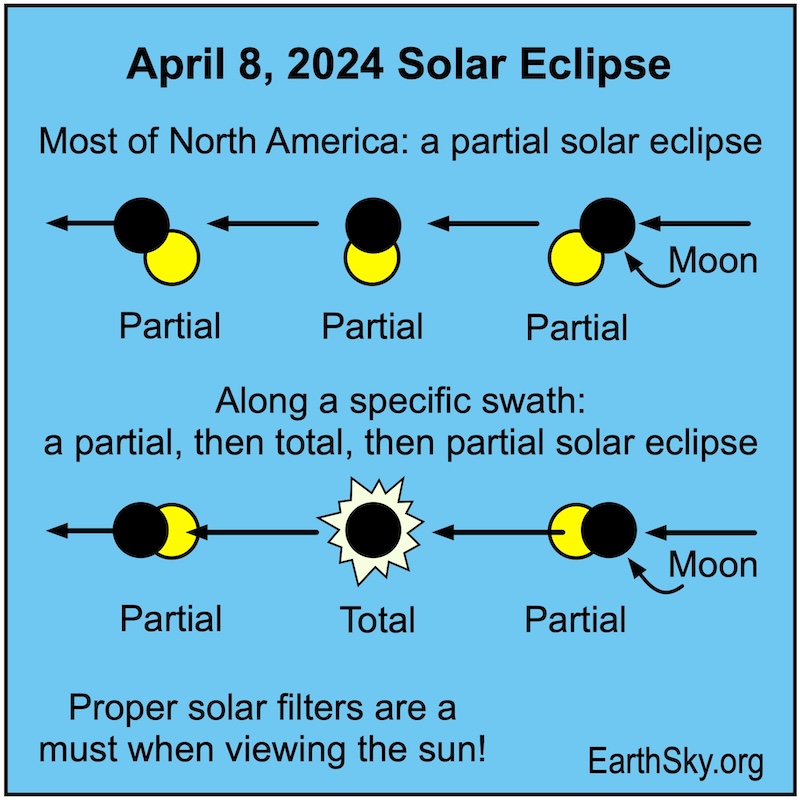
For millions, the biggest event of the year will be the total solar eclipse that will travel along a 115-mile-wide band stretching across North America. On the afternoon of April 8, the moon moves across the disk of the sun. And, if you are in the path of totality, the moon completely covers the sun, revealing a spectacular sight. Observers outside the path will see a partial eclipse, where the moon does not completely cover the sun. To view the partial stages of this event, you must wear proper eclipse glasses. Don’t have any? Order them here before they sell out!
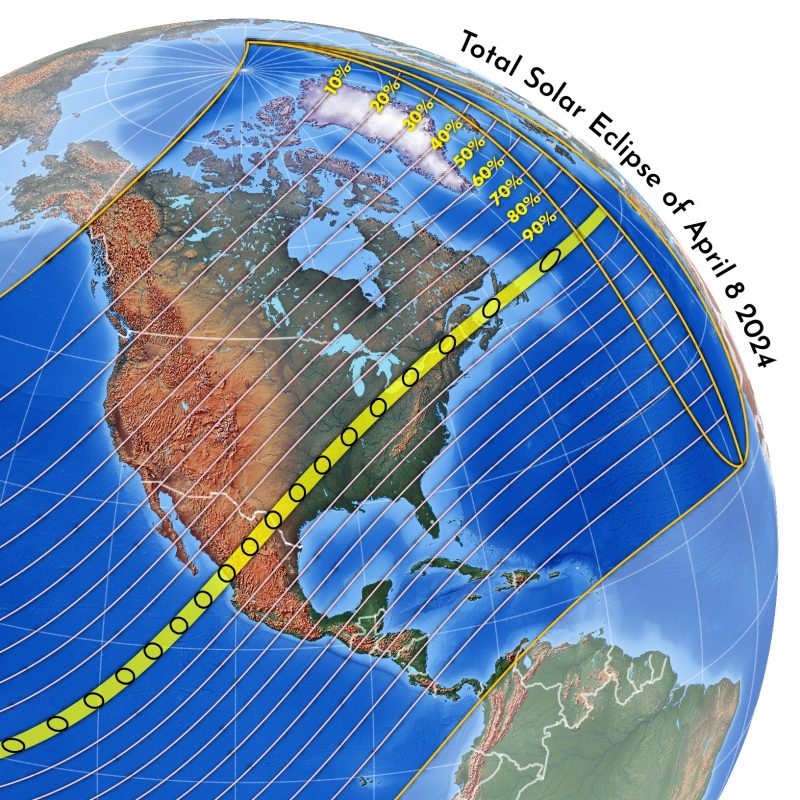
This map shows how much of the sun will be in eclipse by location on April 8, 2024. Image via GreatAmericanEclipse.com. Used with permission.
April 10 and 11: Moon, Jupiter and star clusters create a captivating scene
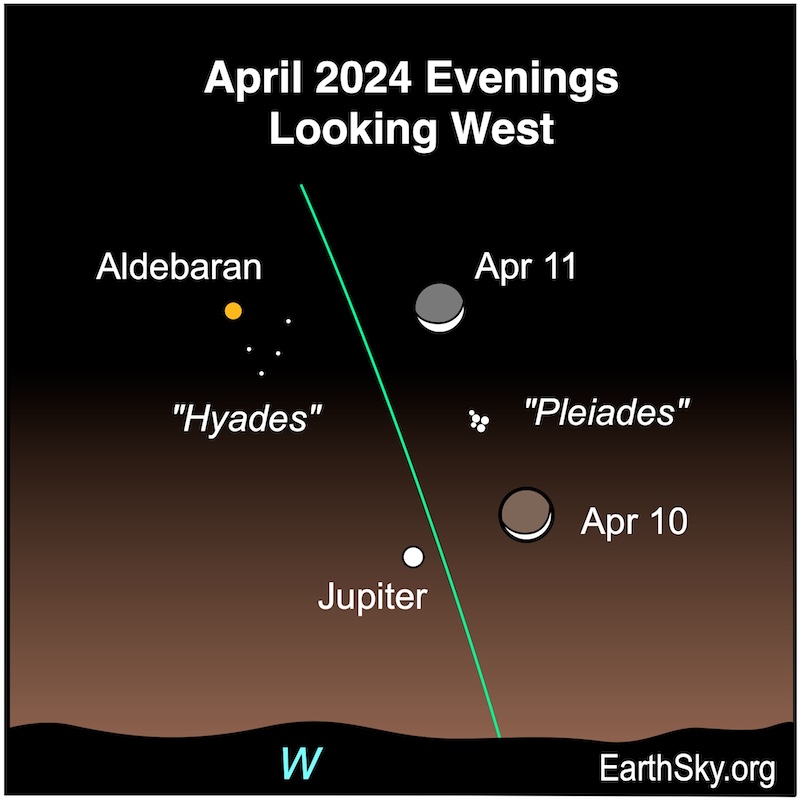
Jupiter, the Pleiades, the Hyades and the crescent moon create 2024’s most captivating scene on the evenings of April 10 and 11. Chart by John Jardine Goss/ EarthSky.
A lovely crescent moon shines near a collection of beautiful objects on the evenings of April 10 and 11. The bright point of light shining nearby is Jupiter. In addition, the dipper-shaped Pleiades star cluster – or Seven Sisters – is a favorite sight among stargazers. And the larger, V-shaped Hyades star cluster with its bright red foreground star, Aldebaran, ranks highly as well. Look west-northwest about an hour after sunset. What a great sight to end your day!
July 7: The crescent moon and Mercury
On the evening of July 7, the thin crescent moon floats immediately above little Mercury in the west shortly after sunset. Chart by John Jardine Goss/ EarthSky.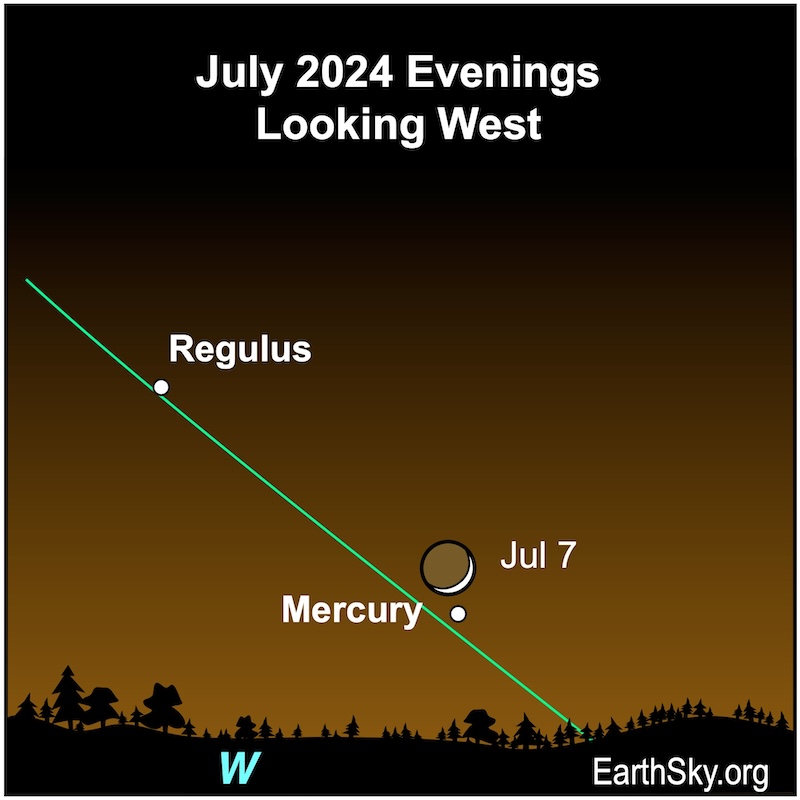
The thin crescent moon – lying low in the bright western-northwestern twilight sky on July 7 – will be a convenient guide for finding little Mercury. Simply look toward the moon about 40 minutes after sunset. The planet will be between the moon and the horizon. Binoculars give a clearer view. Place the moon at the upper edge of the field, and Mercury will be near the field’s center.
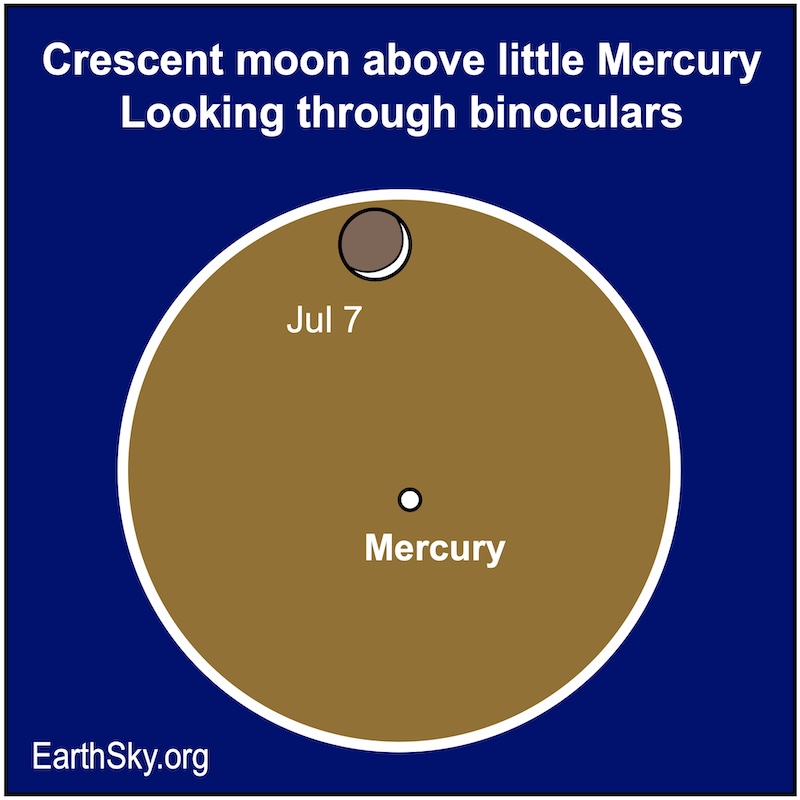
Binoculars will help you enjoy the scene. Mercury will lie in the same field as the moon. Chart by John Jardine Goss/ EarthSky.
July 30 and 31: The crescent moon, Jupiter and Mars
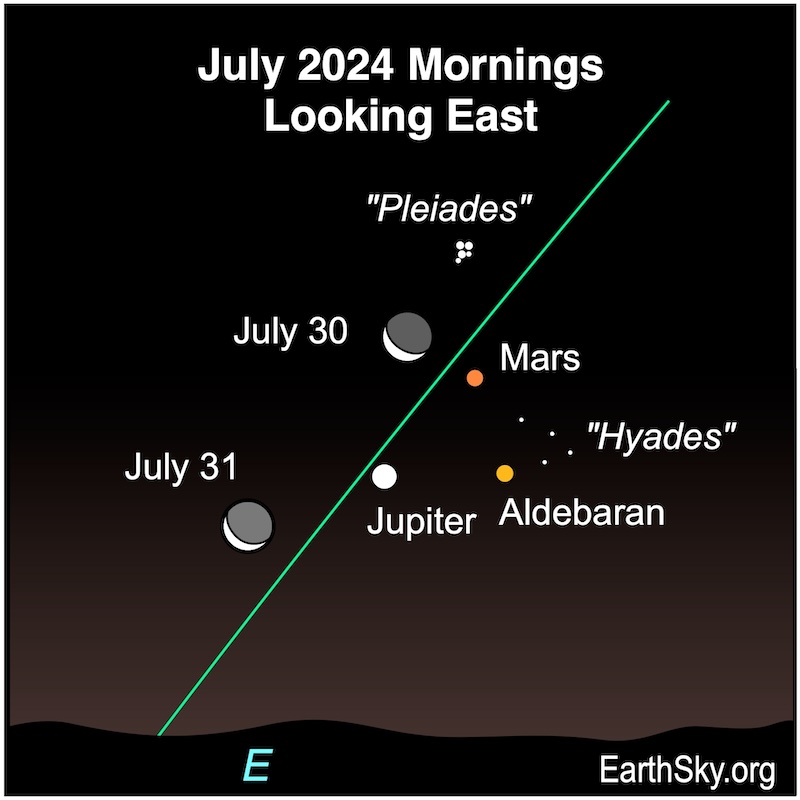
In the early morning hours of July 30 and 31, the crescent moon joins Mars, Jupiter, the Pleiades, Aldebaranand the Hyades for a dramatic scene. Chart by John Jardine Goss/ EarthSky.
An attractive scene plays out on the last two mornings of July. First, on July 30, the crescent moon floats among bright Jupiter, red Mars, the bright star Aldebaran, and the pretty Pleiades star cluster. They’re all in the eastern sky two hours before sunrise. Then, next morning the moon, as an even thinner crescent, hangs below the celestial grouping.
August 12: The Perseus meteor shower peaks
After 11 p.m. on August 11, look to the northeast for upwards of 50 meteors per hour. It continues until dawn on the morning of August 12. Chart by John Jardine Goss/ EarthSky.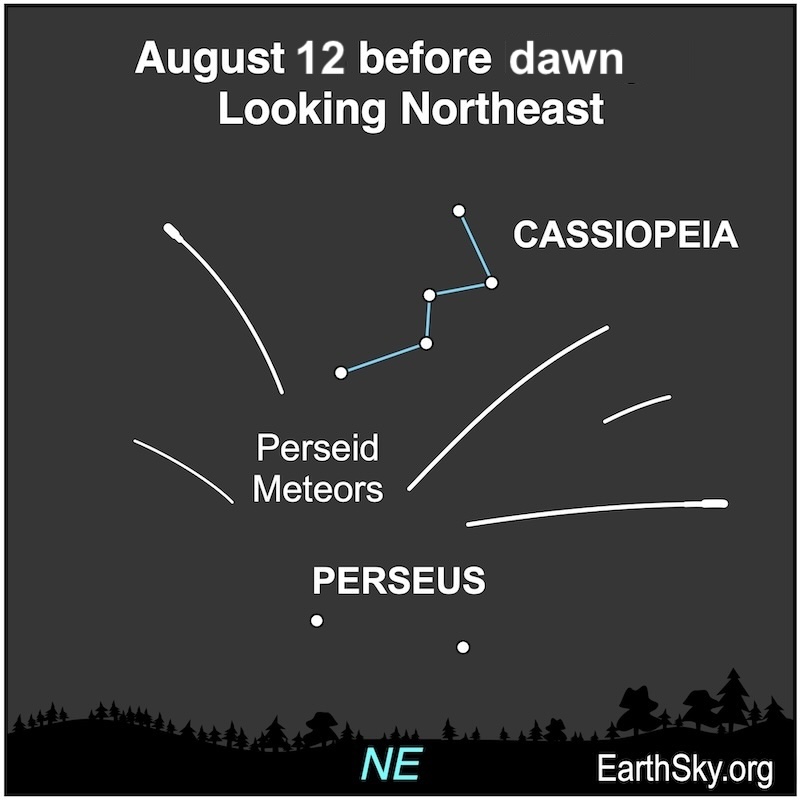
After 11 p.m. local time on August 11, begin looking toward the northeast for streaking meteors from the Perseid meteor shower. You can watch for meteors through dawn on the morning of August 12. Since the moon sets near midnight, its light interferes little with spotting meteors, which may number up to 50 per hour, perhaps more. They appear to emanate from the constellation Perseus, which is near the more familiar W–shaped constellation Cassiopeia. To be sure, the Perseids likely will be 2024’s best meteor shower.
August 14: Conjunction between red Mars and bright Jupiter
Red Mars narrowly misses bright Jupiter in the early morning hours of August 14. Look in the east for this planetary conjunction. Chart by John Jardine Goss/ EarthSky.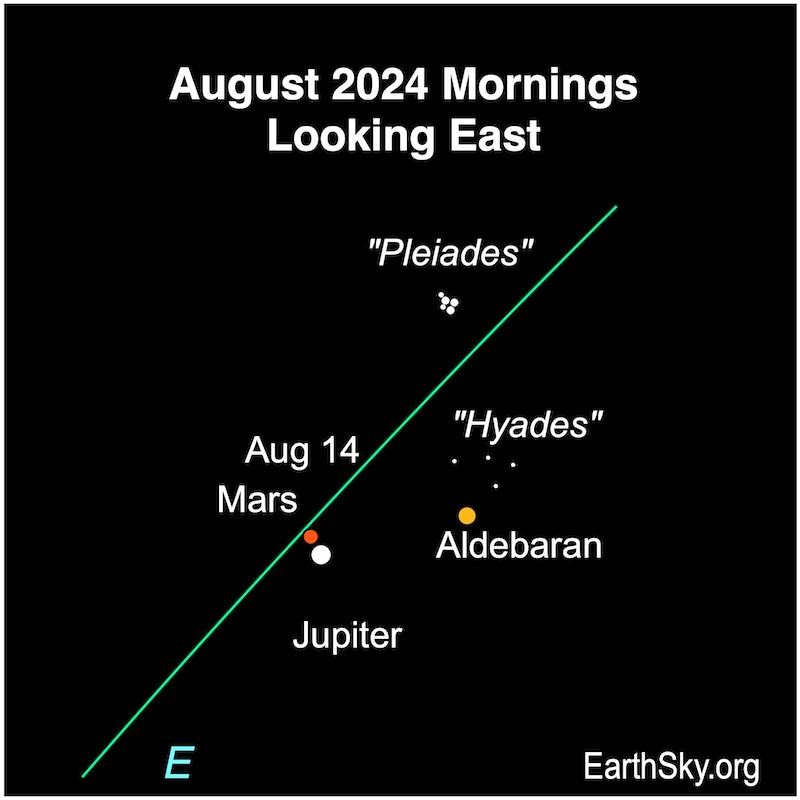
From mid-July through mid-August, red Mars will slowly approach bright Jupiter in Taurus the Bull. Then, on the morning of August 14, Mars will be less than the width of a full moon from Jupiter.
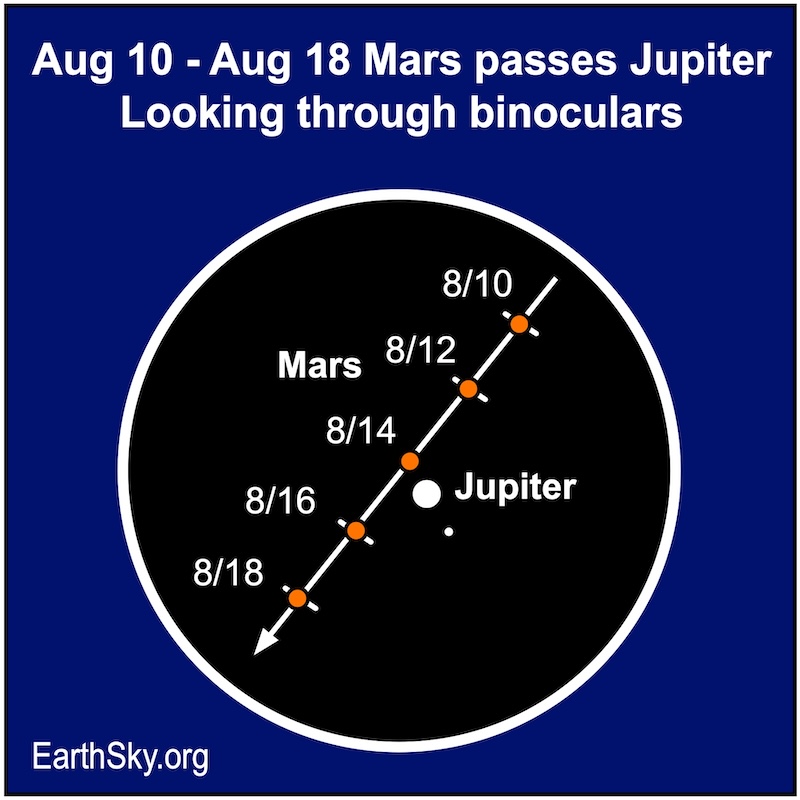
Binoculars will help you see Mars pass bright Jupiter from August 10 through August 18. They’ll be at their closest to each other in the early morning hours of August 14. Chart by John Jardine Goss/ EarthSky.
Late August mornings: 6 planets before sunrise
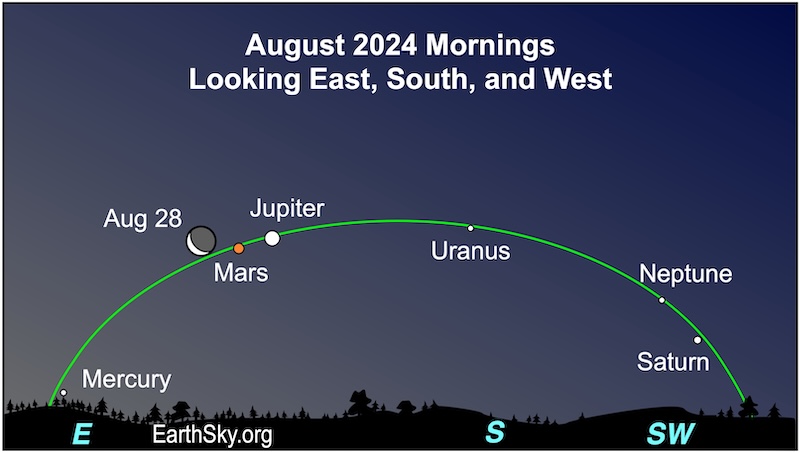
We can always find the planets lying along the ecliptic, which is the plane of our solar system. But often, some of the planets are in the morning sky, while others are in the evening sky, and still others are too close to the sun to see at all. On late August mornings, all the planets – except Venus – appear in the morning sky. Mars, Jupiter and Saturn will be easy. Can you challenge yourself to spot the rest? Chart via John Jardine Goss/ EarthSky.
By this time, you’ve probably already seen Jupiter and Mars in the morning sky, coming off their conjunction in mid-August. You’ve probably spotted Saturn, too, farther to the west. But in late August, there are six planets in the morning sky. Can you challenge yourself to spot them all? Mercury will be rising before the sun. The later in the month you look, the better your chance to see it, creeping up from the eastern horizon. Uranus and Neptune will require optical aid and finder charts. Uranus is currently in Taurus while Neptune is in Pisces. You can use Stellarium to help track them down.
October 5, November 4 and December 4: The crescent moon meets Venus
In the southwest in the early evening hours of October 5, November 4, and December 4, the waxing crescent moon will glow next to brilliant Venus. Chart by John Jardine Goss/ EarthSky.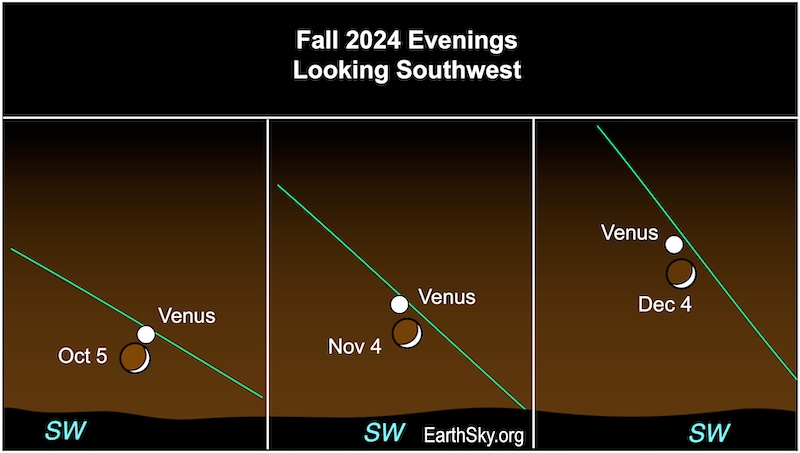
Some of the most eye-catching sky sights happen when a crescent moon appears near the brightest planet, Venus. Indeed, three such occasions occur in fall’s evening sky. As the twilight sky deepens after sunset on October 5, November 4 and December 4, look toward the western horizon for a dramatic scene. Venus will be unmistakable shining next to the waxing crescent moon.
October 14 to 24: Comet Tsuchinshan–ATLAS at its brightest
If we are fortunate, a comet will grace our sky from October 14 to 24. Look to the west shortly after sunset for Comet Tsuchinshan–ATLAS. Chart by John Jardine Goss/ EarthSky.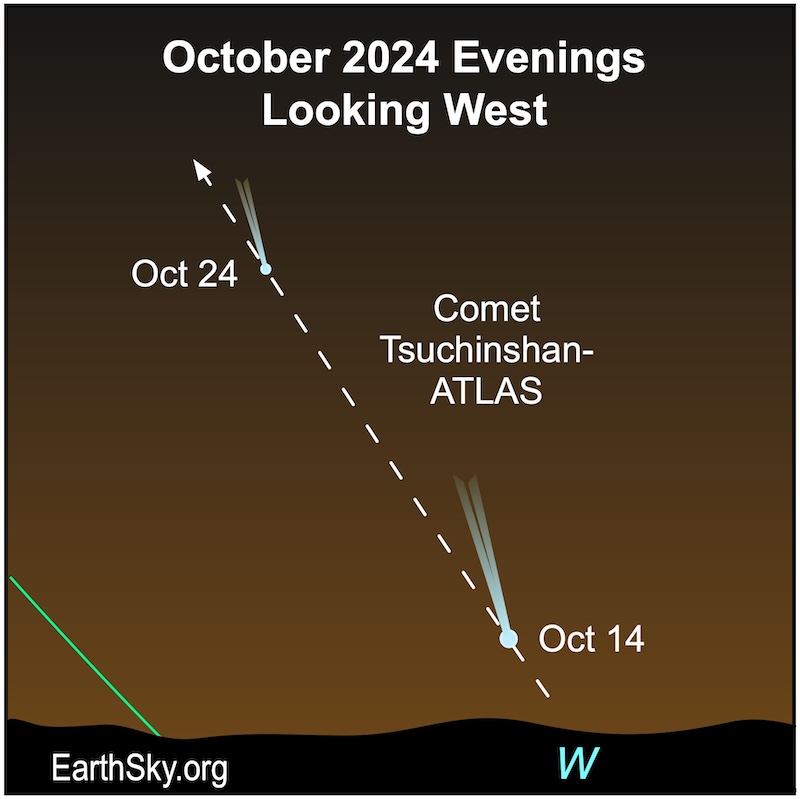
A beautiful, graceful cometary apparition might be in store for us. It’s been a while since we’ve had a wispy comet tail stretch across our evening sky. This October, in particular October 14 through 24, Comet Tsuchinshan–ATLAS could be bright in the early evening sky. With ten months to go, all looks good for a great showing.
November 12: Venus shines near a mysterious glow
An hour after sunset on November 12, look at brilliant Venus through binoculars. It shines in the southwest. Above it in the same field lies the star-forming nebula M8, the Lagoon Nebula. Chart by John Jardine Goss/ EarthSky.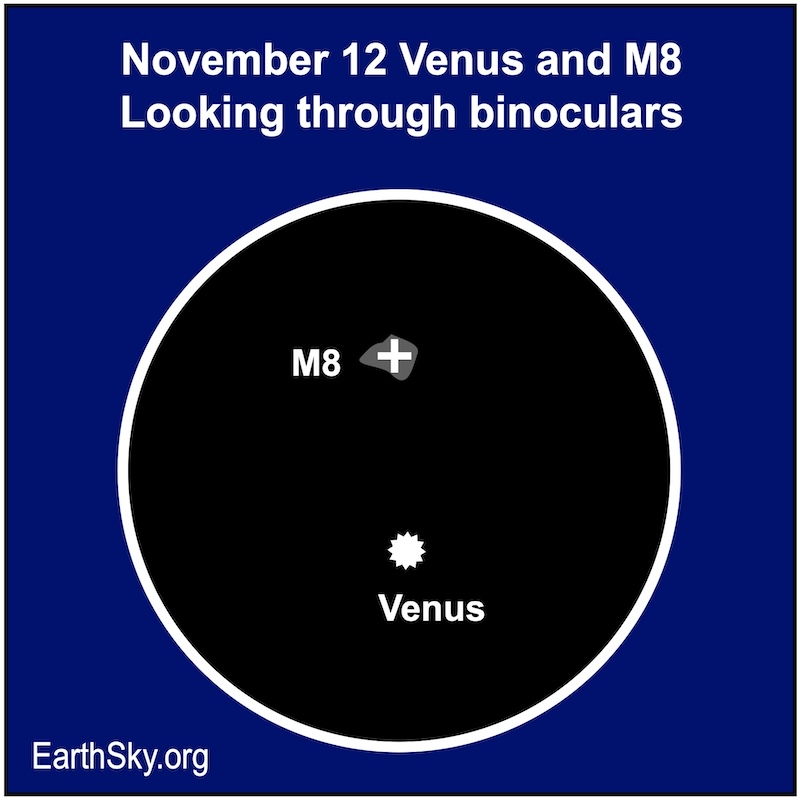
Brilliant Venus will shine low above the southwestern horizon on November 12 about an hour after sunset. And, just above it lies the mysterious star-forming nebula, M8, or the Lagoon Nebula. Center Venus in binoculars and the indistinct glow of M8 will become apparent.
December 5: Mars meets stellar bees
Looking southwest early on the morning of December 5, red Mars tangles with the Beehive star cluster. The twin stars of Gemini, Castor, and Pollux, lie nearby. Chart by John Jardine Goss/ EarthSky.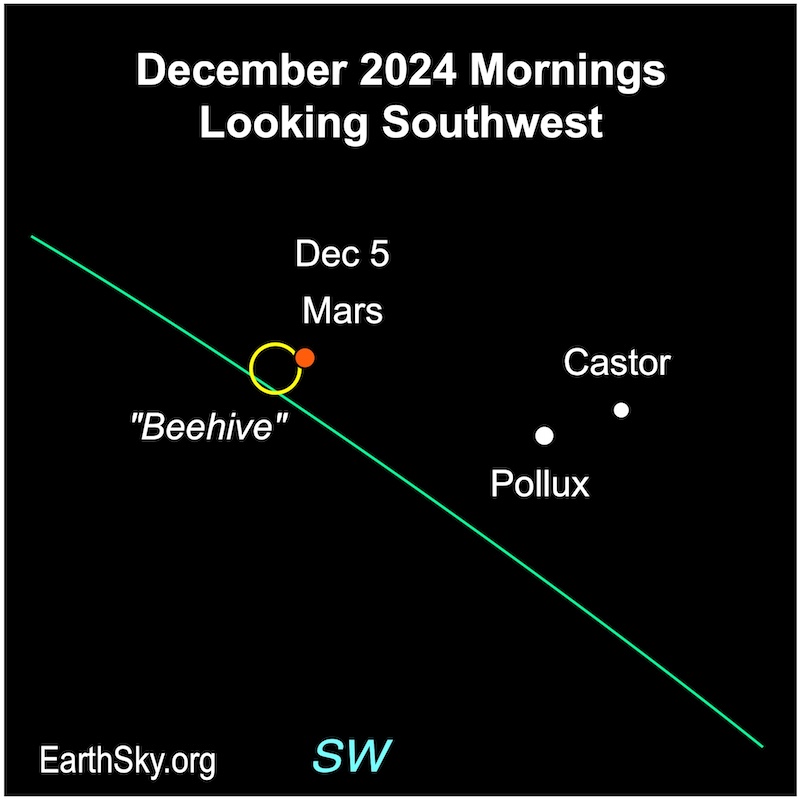
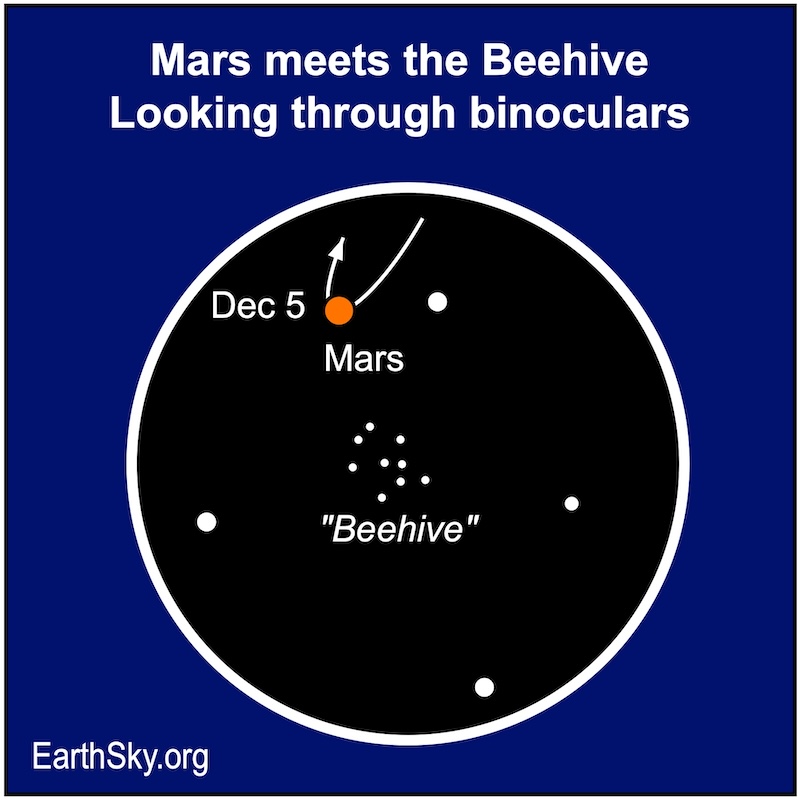
In the morning on December 5, binoculars will help show bright Mars approaching the much dimmer Beehive star cluster. Chart by John Jardine Goss/ EarthSky.
Bottom line: Check out the best sky scenes of 2024! A total solar eclipse crosses North America, planets have close pairings, a comet may shine bright, and more!