
June 6, Earth will reach its farthest point from the sun in its orbit. But it’s summer in the Northern Hemisphere! How can that be? Plus, a big asteroid passed close to Earth last last weekend. Should we worry?
July 6: Earth at aphelion
Our planet Earth reaches aphelion – its greatest distance from the sun for this year – at 12:30 p.m. CDT (17:30 UTC) on July 6. At that time, Earth will be 94,502,961 miles (152,087,774 km) from the sun. Michael Teoh submitted this composite image of the sun from Malaysia and wrote: “A comparison of the angular size of the sun during the most recent aphelion (farthest point) in 2025 and perihelion (closest point) in 2026. The angular diameter of the sun during the perihelion of 2026 was about 3.4% larger than it was during the aphelion of 2025.” 
July evening planets: Northern Hemisphere view
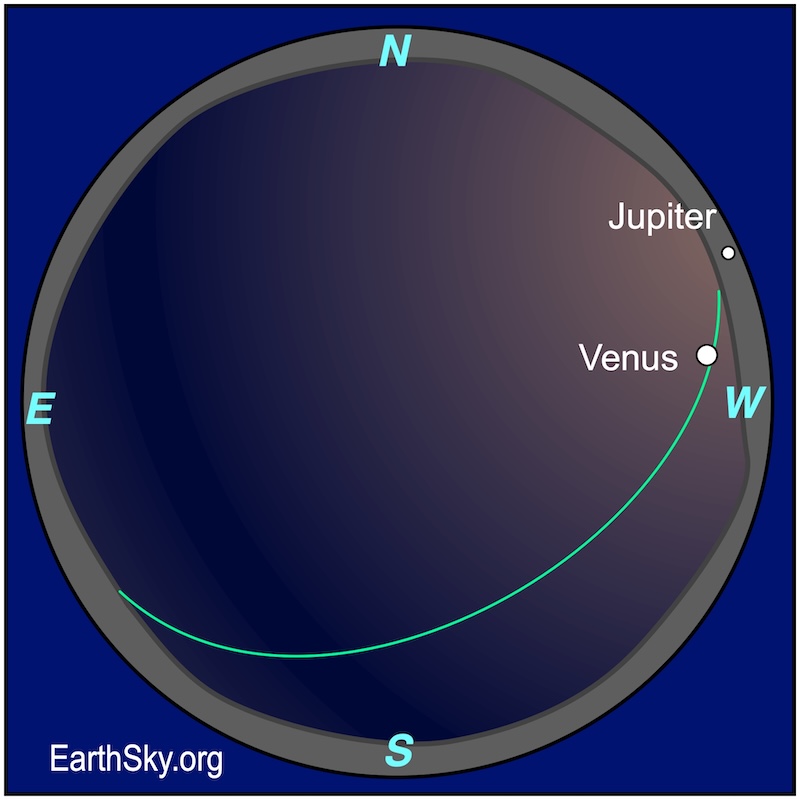
This all-sky chart shows bright Jupiter and Venus about 60 minutes after sunset, in early July. Each day, Venus will ascend higher as it races toward its greatest distance from the sun on August 14-15. Jupiter, on the other hand, is falling quickly below the sunset horizon in the evening twilight. It’ll be gone early in the month for mid-latitudes in the Northern Hemisphere, and by mid-month for tropical latitudes. It’ll be most directly behind the sun from Earth on July 29. And it’ll return – to the east before dawn this time – in September. Note that planets lie along the ecliptic, the path the sun travels in the daytime (the green line on our chart). Chart via EarthSky.
July morning planets: Northern Hemisphere view
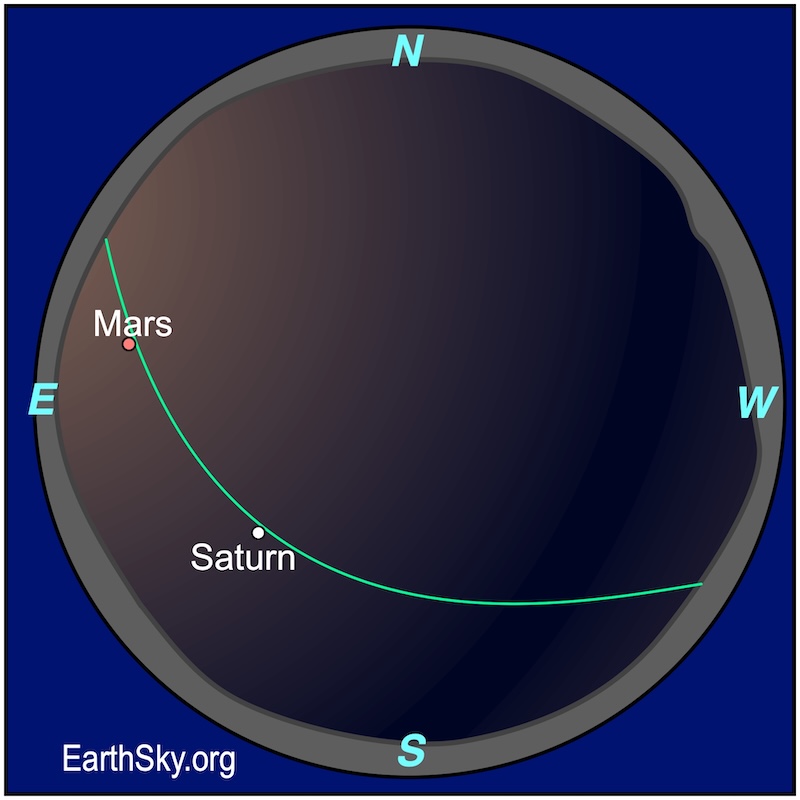
This all-sky chart shows Mars and Saturn – around the first week of July – in the east shortly before sunrise. Saturn is farther away, but it’s bigger; it’ll be the brighter of the 2 planets. Note that the planets lie along the ecliptic, the path the sun travels in the daytime (the green line on our chart). Chart via EarthSky.
July 7: Watch for the 3rd quarter moon
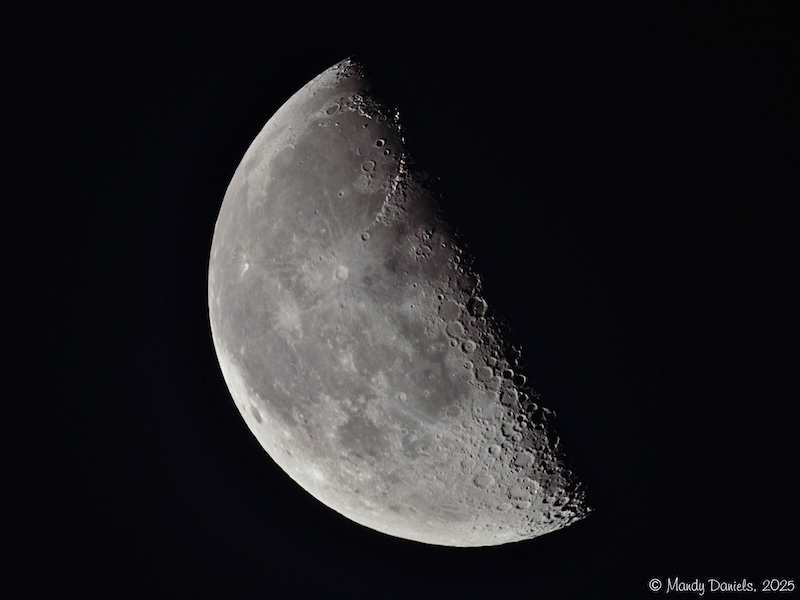
View at EarthSky Community Photos. | Mandy Daniels captured this image of the last quarter moon on September 14, 2025, in the UK. Thank you, Mandy! The moment of the 3rd quarter moon will fall at 19:29 UTCon July 7, 2026. That’s 2:29 p.m. Central Daylight Time in the Americas. And it’s 7:29 a.m. New Zealand Standard Time on July 8. It’ll rise after midnight your local time and set around noon. Look for it high in the sky before dawn.
July 7 and 8 mornings: Moon near Saturn
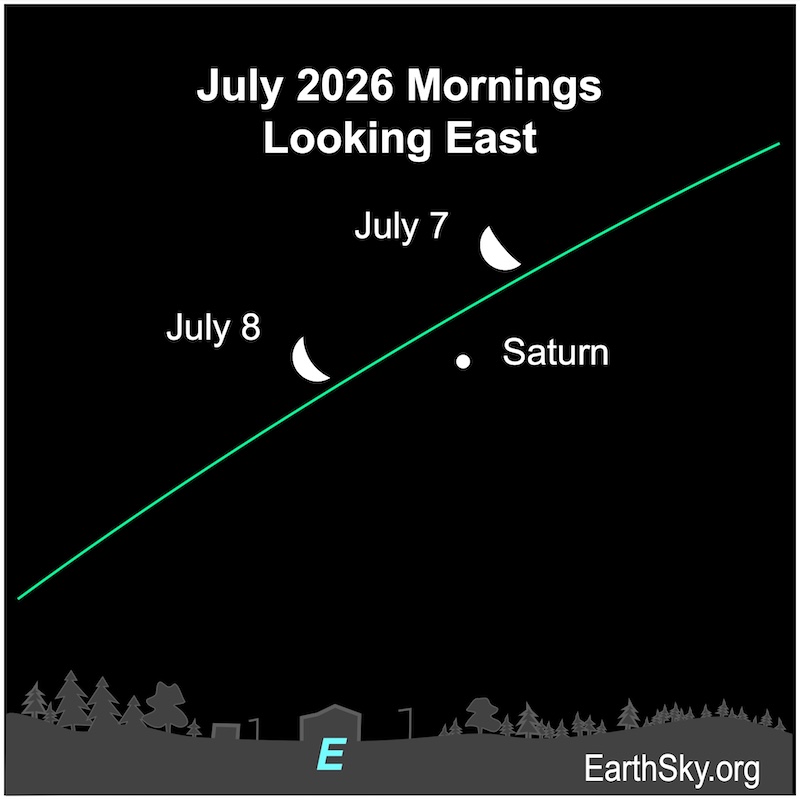
On the mornings of July 7 and 8, the moon will shine near Saturn. They will rise after midnight, so you can catch them through dawn. Chart via EarthSky.
July 10 and 11 mornings: Moon near Aldebaran, Mars and the Pleiades
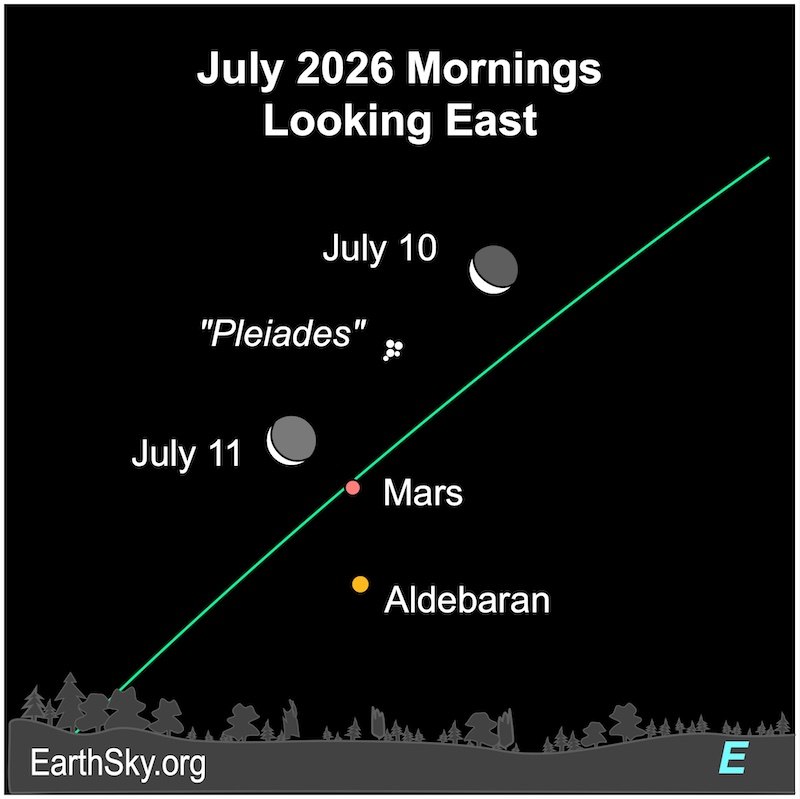
On July 10 and 11, the waning crescent moon will lie near reddish Mars and the ruddy star Aldebaran. Also, the delicate Pleiades star cluster will glitter nearby. Look for them about 90 minutes before sunrise. Chart via EarthSky.
July 12 and 13 mornings: Moon near Aldebaran, Mars, and the Pleiades
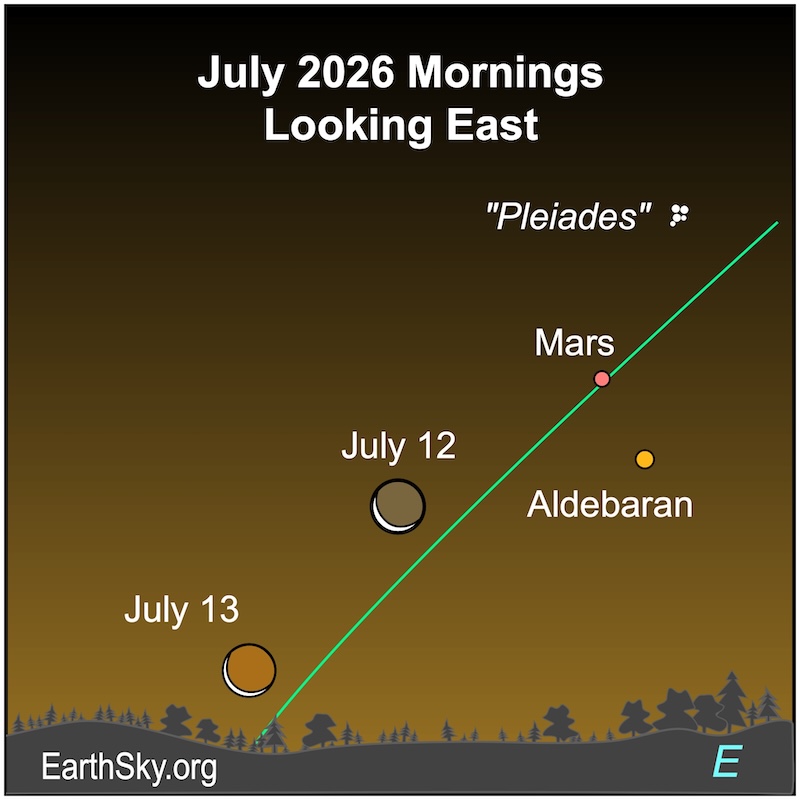
About 30 minutes before sunrise on July 12 and 13, look for the waning crescent moon, glowing with earthshine. It’ll lie near the red planet Mars and the bright orange giant star Aldebaran. Also, the tiny dipper-shaped Pleiades star cluster is nearby. Chart via EarthSky.
July 14: New moon

This GOES-19 CORR1 coronagraph from November 18-19, 2025 (designed to show coronal mass ejections from the sun), captured a fun view of the new moon, which would normally not be visible from Earth during this phase. The moment of new moon will fall at 9:44 UTC on July 14, 2026. That’s 4:44 a.m. Central Daylight Time in the Americas. And it’s 9:44 p.m. New Zealand Standard Time. In fact, this is the 4th of 5 new supermoons in a row. It’ll be 223,789 miles (360,154 km) away. Compare that with the average moon distance of 238,900 miles (384,472 km). New moons rise and set with the sun. Nights around the new moon are perfect for stargazing. See EarthSky’s best places to stargaze. Images via NOAA/ GOES.
July 15 evening: Moon near Venus and Regulus
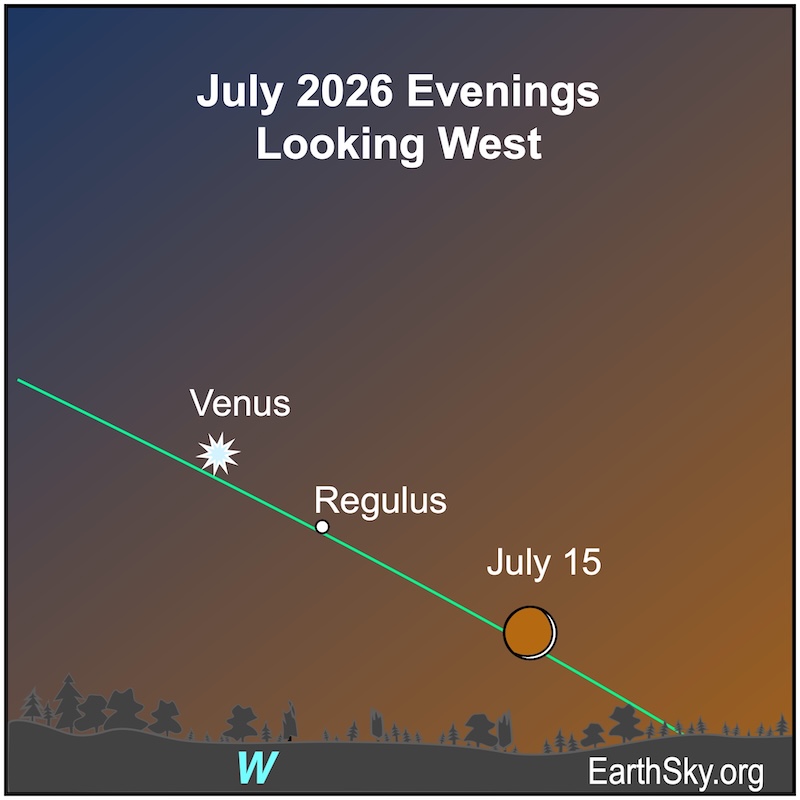
On the evening of July 15, the waxing crescent moon will be approaching brilliant Venus and Regulus, the brightest star in Leo the Lion. Chart via EarthSky.
July 16 and 17 evenings: Moon close to Venus and Regulus
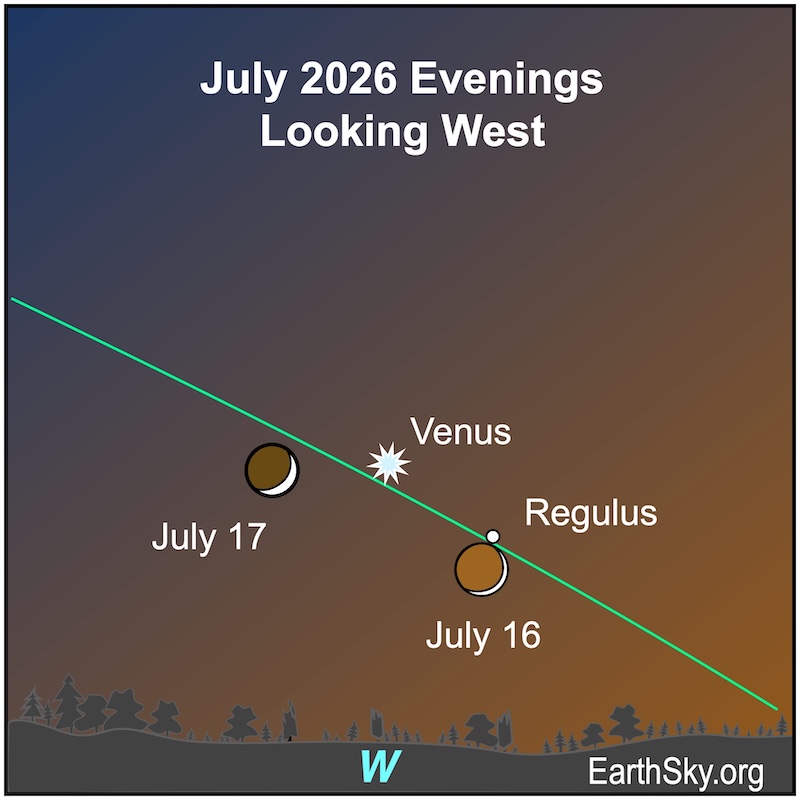
On the evenings of July 16 and 17, the waxing crescent moon will lie near brilliant Venus and Regulus, the brightest star in Leo the Lion. Regulus is the bright dot at the bottom of a backward question-mark pattern of stars known as the Sickle. Also, look for the delicate glow of earthshine on the unlit portion of the moon. They’ll set late evening. Chart via EarthSky.
July 20 evening: Moon and Spica
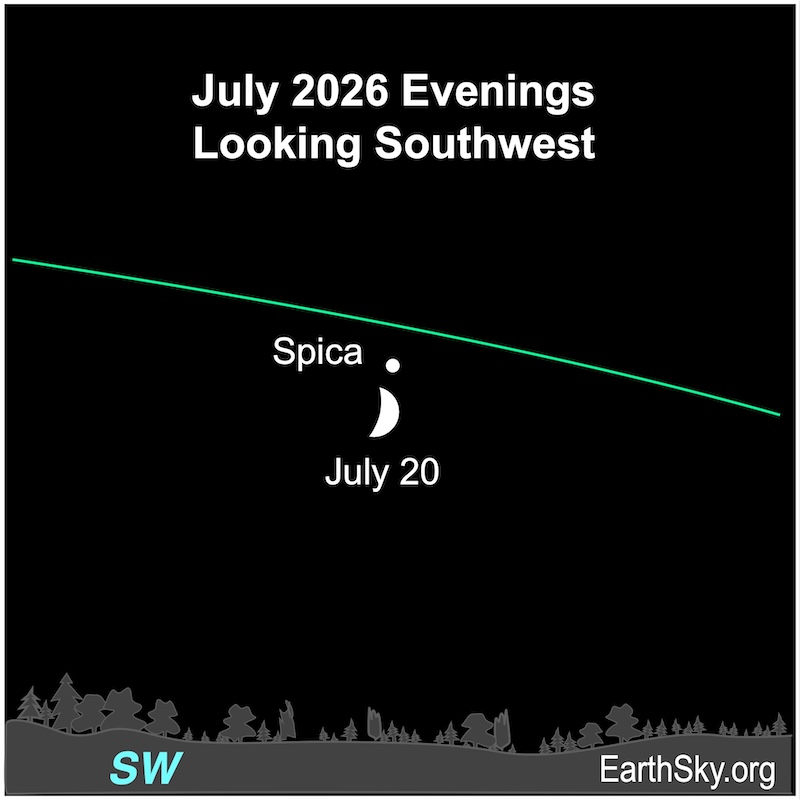
The almost first-quarter moon will float close to the bright star Spica after twilight subsides in the evening of July 20. Spica is the brightest star in the constellation of Virgo, the Maiden. Chart via EarthSky.
July 21: 1st quarter moon
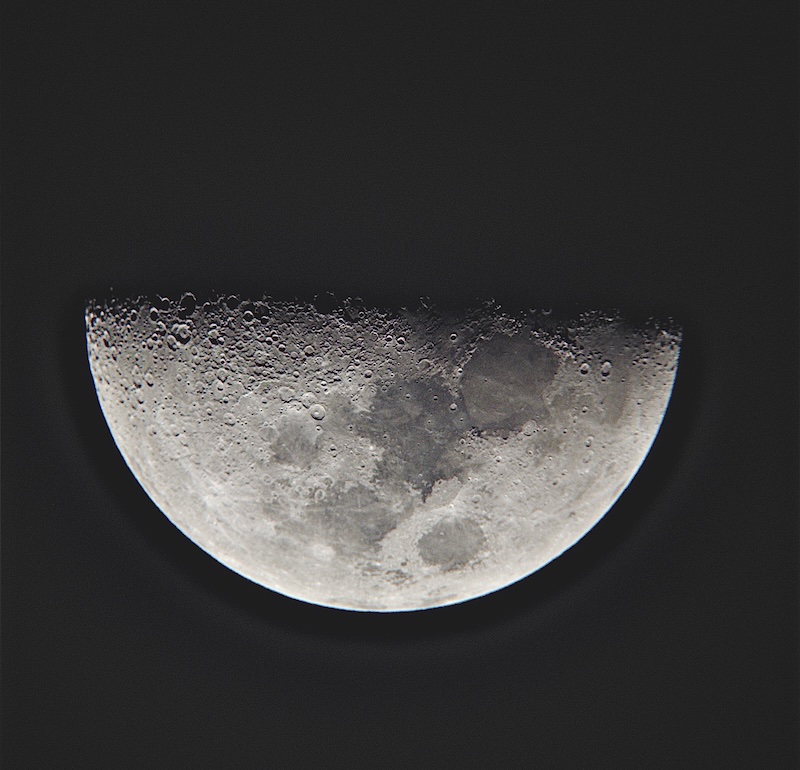
Amol Gaikaiwari took this picutre on May 23, 2026, in India and wrote: “The moon was in its first quarter phase. It was roughly 51% illuminated, with half of the lunar disk brightly lit against the night sky.” Thank you, Amol! This month’s moment of 1st quarter moon will fall at 11:06 UTC on July 21, 2026. That’s 5:06 a.m. Central Daylight Time in the Americas. And it’s 11:06 p.m. New Zealand Standard Time. A 1st quarter moon rises around noon your local time and sets around midnight. Watch for a 1st quarter moon high in the sky at sundown.
July 23 and 24 evenings: Moon near Antares
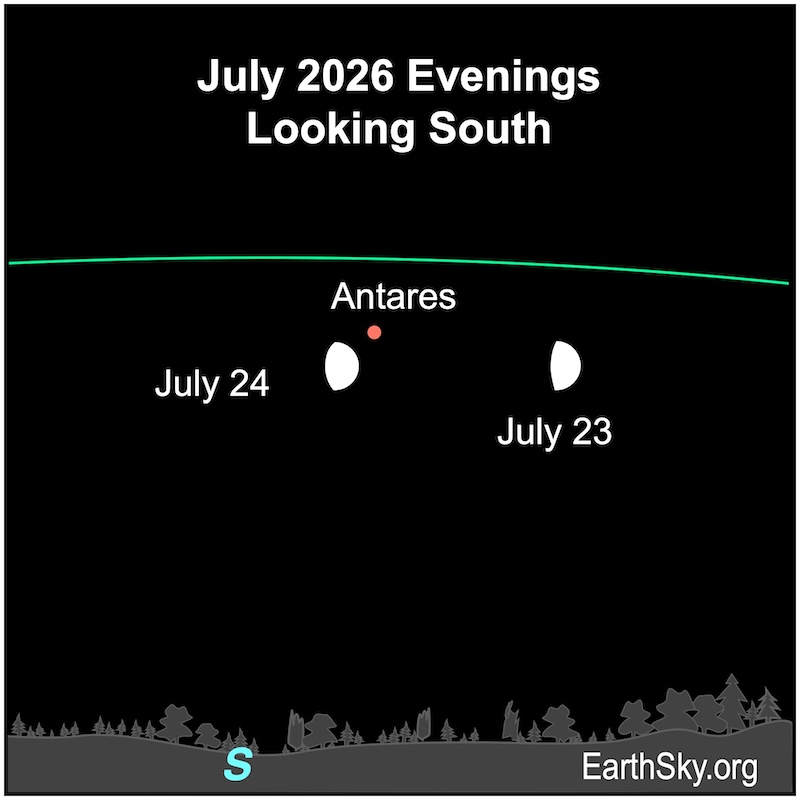
After sunset on July 23 and 24, the bright waxing gibbous moon will shine near Antares. Antares is the brightest star in Scorpius, the Scorpion. Chart via EarthSky.
Late July: Watch for the Delta Aquariid meteors
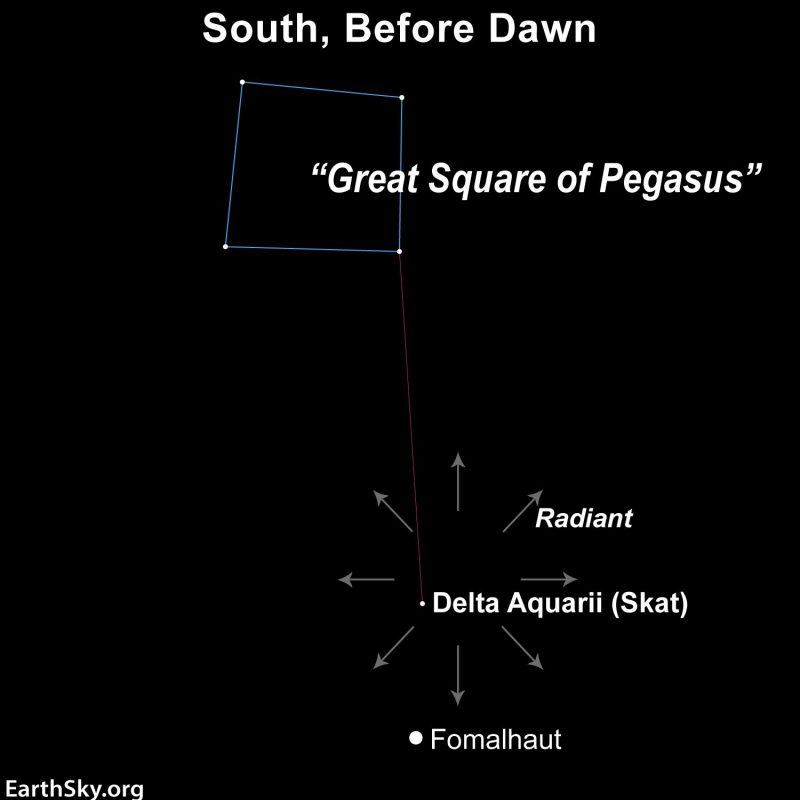
The radiant point for the Delta Aquariid meteor shower is near the faint star Skat, or Delta Aquarii. It rises in mid-evening, is highest around 2 a.m. and low in the sky by dawn. Use the bright, nearby star Fomalhaut to guide you to the Delta Aquariid radiant point. Find Fomalhaut by drawing a line southward through the stars on the west side of the Great Square of Pegasus. This chart shows a wide area, from overhead to southward, as seen from the Northern Hemisphere. From the Southern Hemisphere, the radiant is closer to overhead. In 2026, the full moon falls at 14:36 UTC on July 29. Take advantage of the moon-free mornings – after midnight – the week before for watching the Delta Aquariids (and the early Perseids).
July 25 and 26 evenings: Moon near Teapot
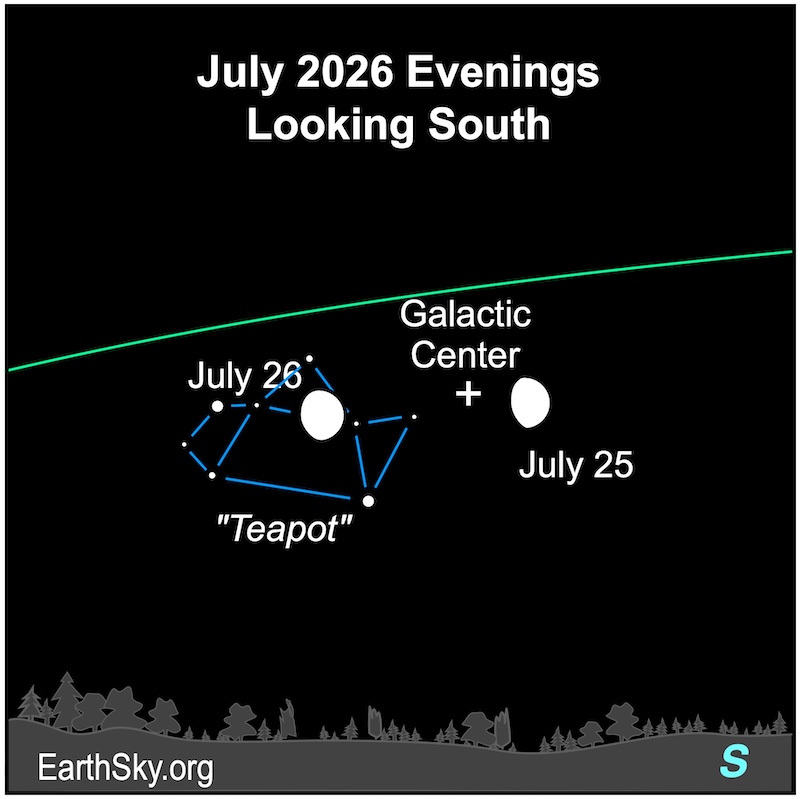
On the evening of July 25, the waxing gibbous moon will float near the Teapot asterism of Sagittarius and near the spot that marks the center of the Milky Way galaxy. On the next evening, July 26, the moon will float among the stars of the Teapot. Due to the brightness of the moon, the Teapot will be difficult to discern on both evenings. They’ll rise before sunset and set before dawn the next morning. Chart via EarthSky.
July 27 evening: Moon near Teapot
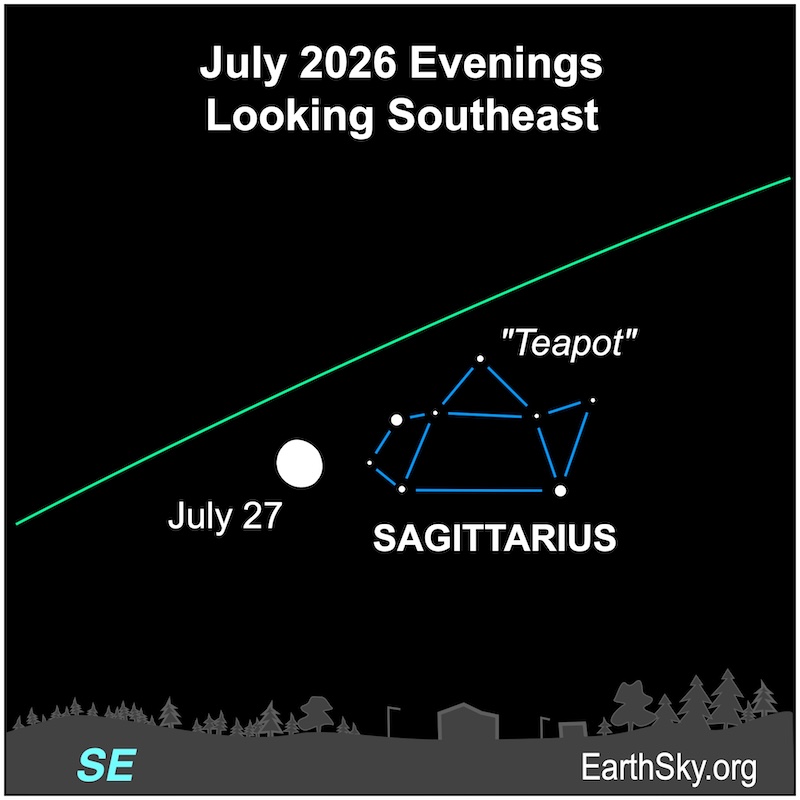
On the evening of July 27, the bright full moon, just hours past its peak, will hang near the stars of the asterism of Sagittarius called the Teapot. Chart via EarthSky.
July 28 overnight: Full Buck Moon
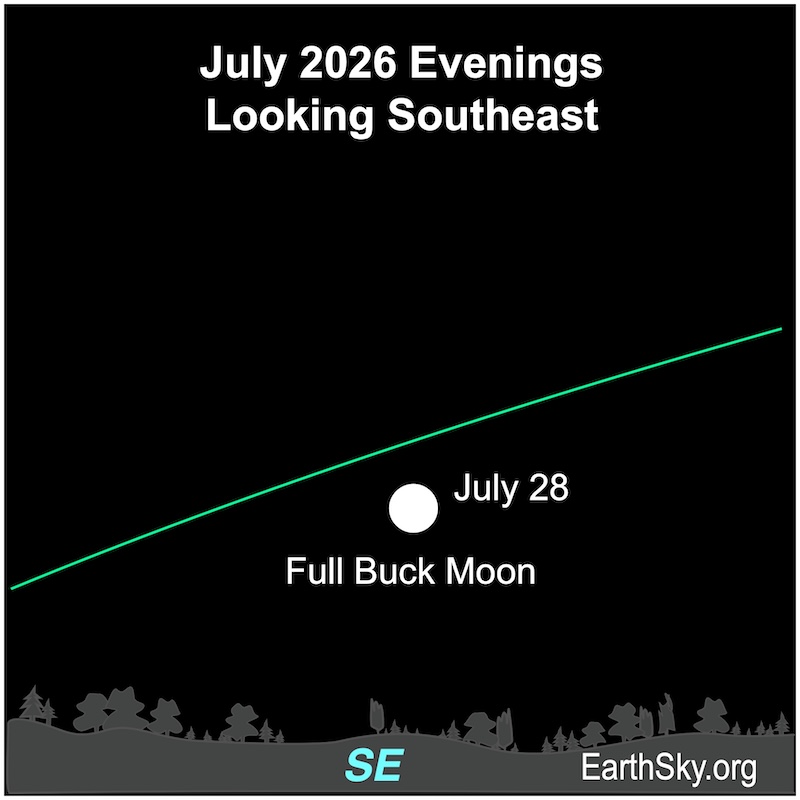
The almost full moon will rise in the east opposite the sunset on the evening of July 28. The July full Buck Moon will occur at 14:36 UTC on July 29. That is 9:36 a.m. Central Daylight Time in the Americas. And it’s 2:36 a.m. New Zealand Standard Time on July 30. Chart via EarthSky.
July 29 and 30 evenings: Moon and Capricornus
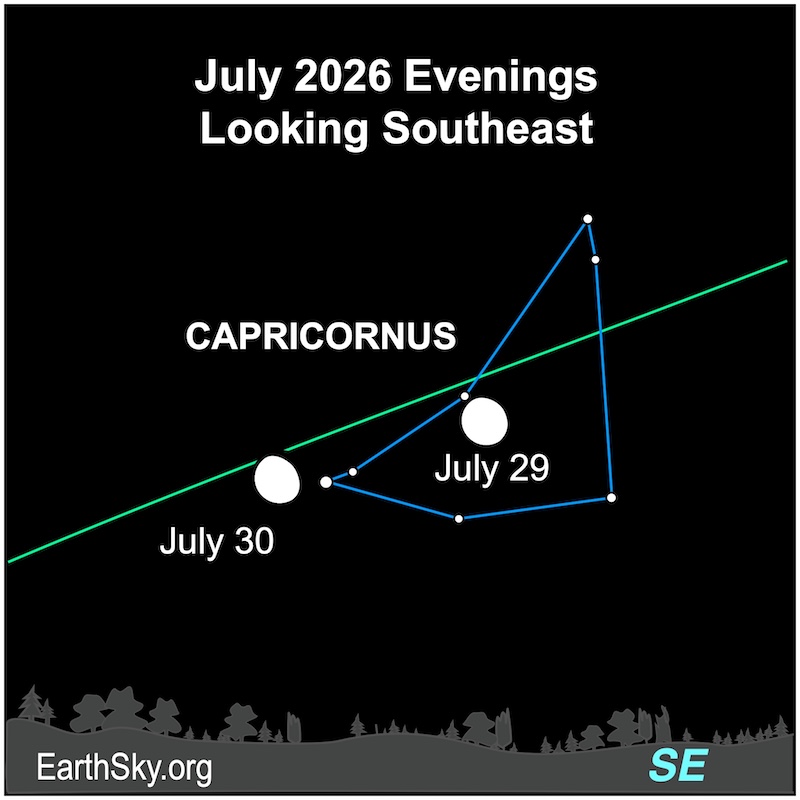
In the late evening of July 29, the bright waning gibbous moon will hang among the 7 stars of the constellation Capricornus, the Sea-goat. The moon’s brightness will likely overpower the constellation. On the next evening, July 30, the moon is near the arrowhead-shaped pattern of stars making up Capricornus. Chart via EarthSky.
July evening planets
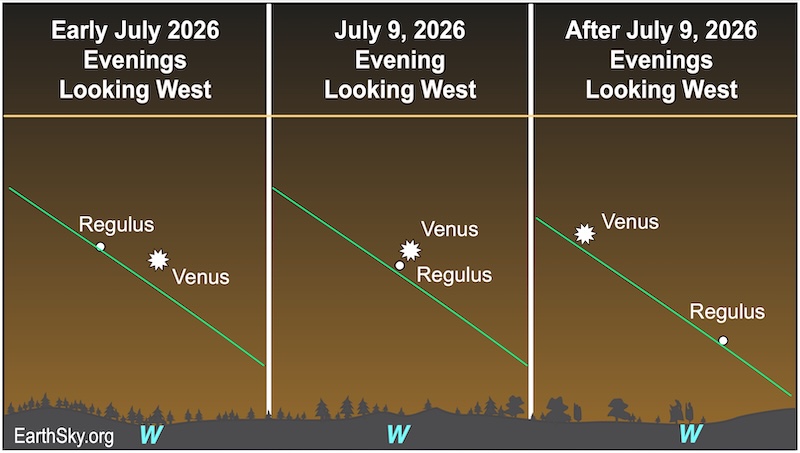
Bright Venus will rise slightly higher shortly after sunset each evening all month. It will pass the star Regulus on July 9, then they’ll drift apart. Venus will ascend higher each night as it races toward its greatest distance from the sun on August 14-15. Chart via EarthSky.
July morning planets
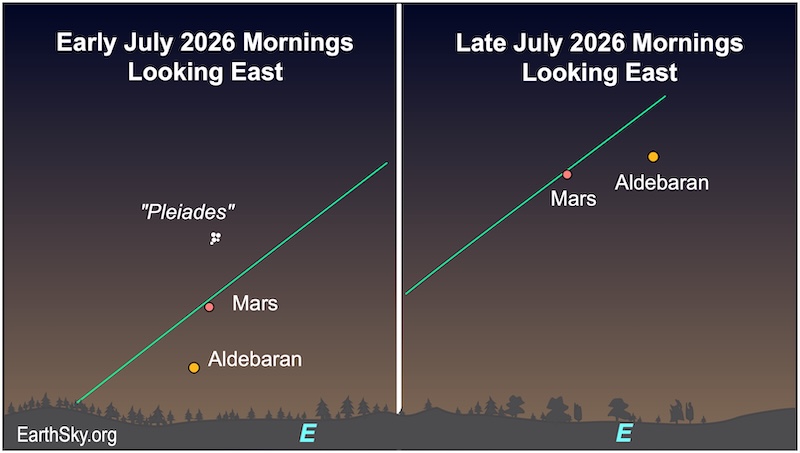
In the first half of July, Mars will lie low in the bright eastern twilight shortly before sunrise. It slides between the Pleiades star cluster and the bright star Aldebaran. In the second half of the month, Mars will rise higher while moving past Aldebaran. Chart via EarthSky.
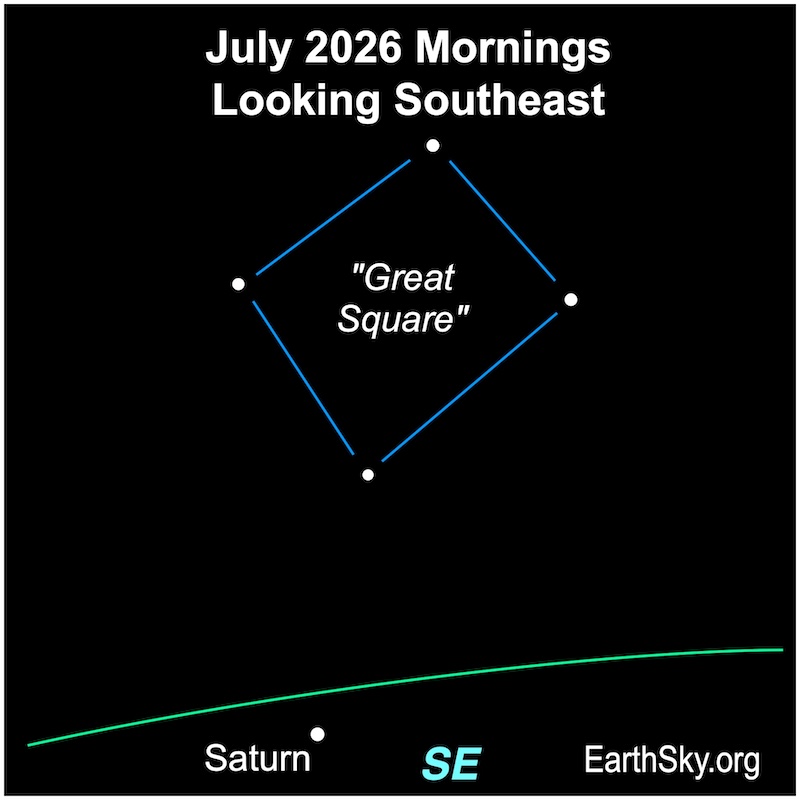
Saturn will lie in the south in the early morning hours of July. It’s the bright object to the lower left of the 4 moderately bright stars that comprise the Great Square asterism. Chart via EarthSky.
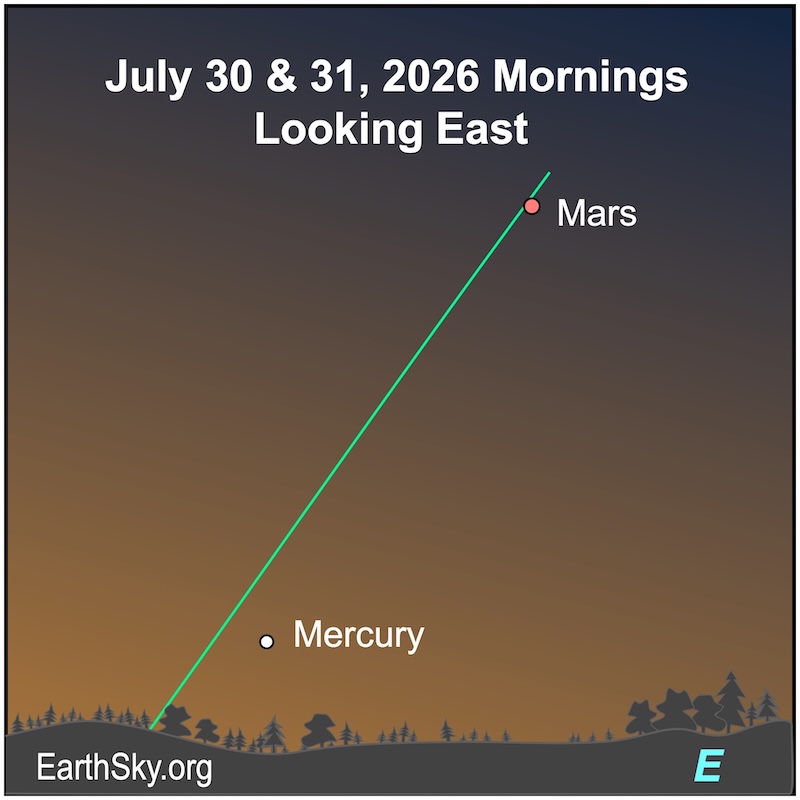
From the Northern Hemisphere, on the last 2 mornings of July, Mercury will shine low in the east in the bright twilight. Higher in the sky is the red planet Mars. Mercury will reach its greatest distance from the sun on the morning of August 2. Chart via EarthSky.
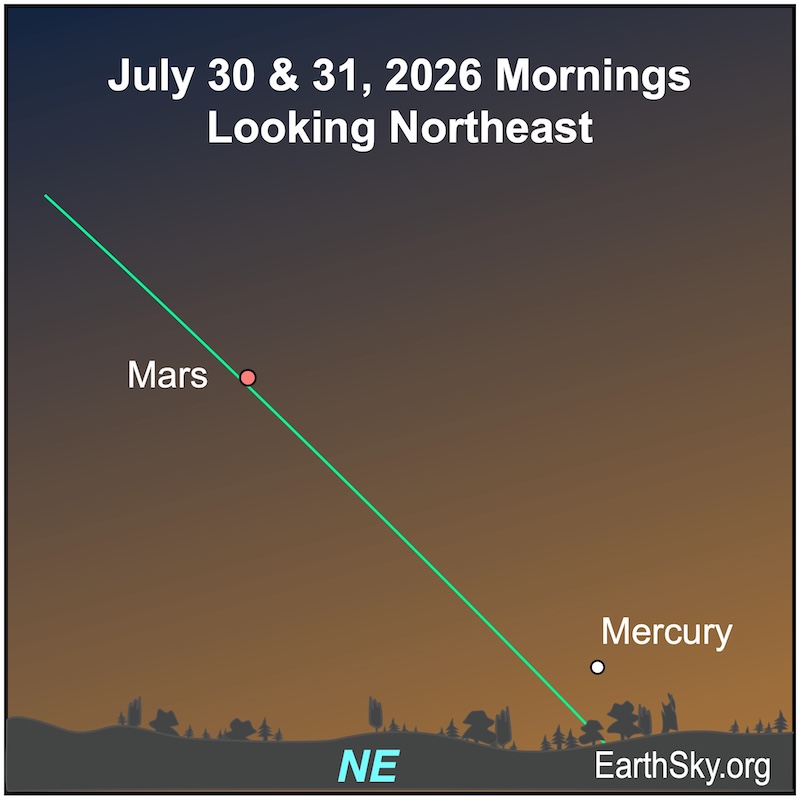
For Southern Hemisphere viewers, Mercury will lie low in the east during the last 2 mornings of July. Also, look for Mars higher in the sky. Mercury will reach its greatest distance from the sun on the morning of August 2. Chart via EarthSky.
July stars
If you’re out stargazing on any July evening, look for these stars and constellations overhead in the sky.
Hercules the Hero and the Hercules Cluster
Hercules is a faint constellation. But its midsection contains the easy-to-see Keystone asterism. You can find Hercules between the bright stars Vega in Lyra, the Harp, and Arcturus in Boötes the Herdsman. And once you find the Keystone, you can easily locate M13, the Hercules cluster. Chart via EarthSky.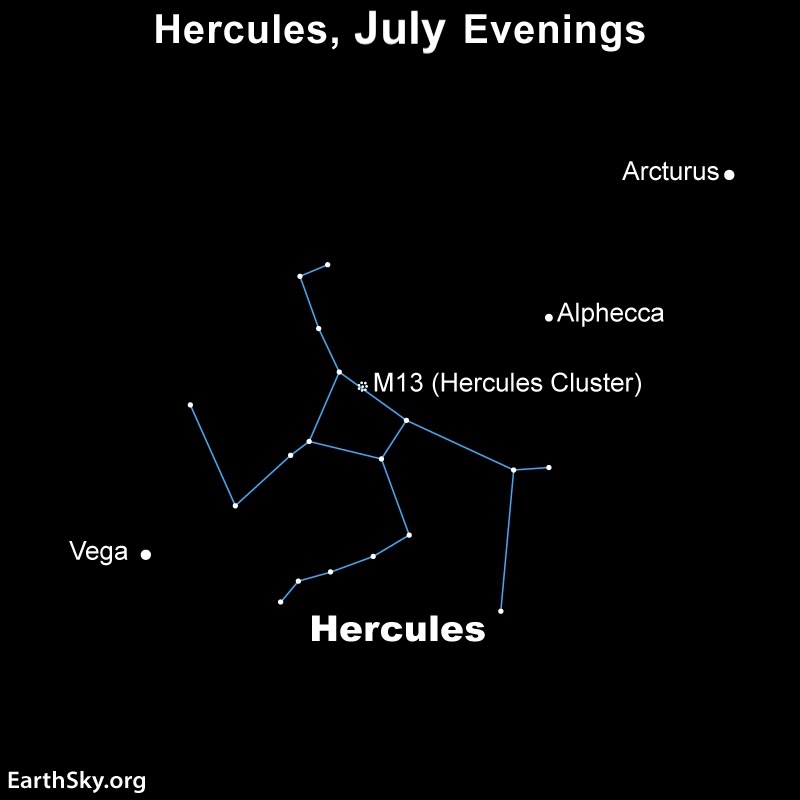
Lyra the Harp
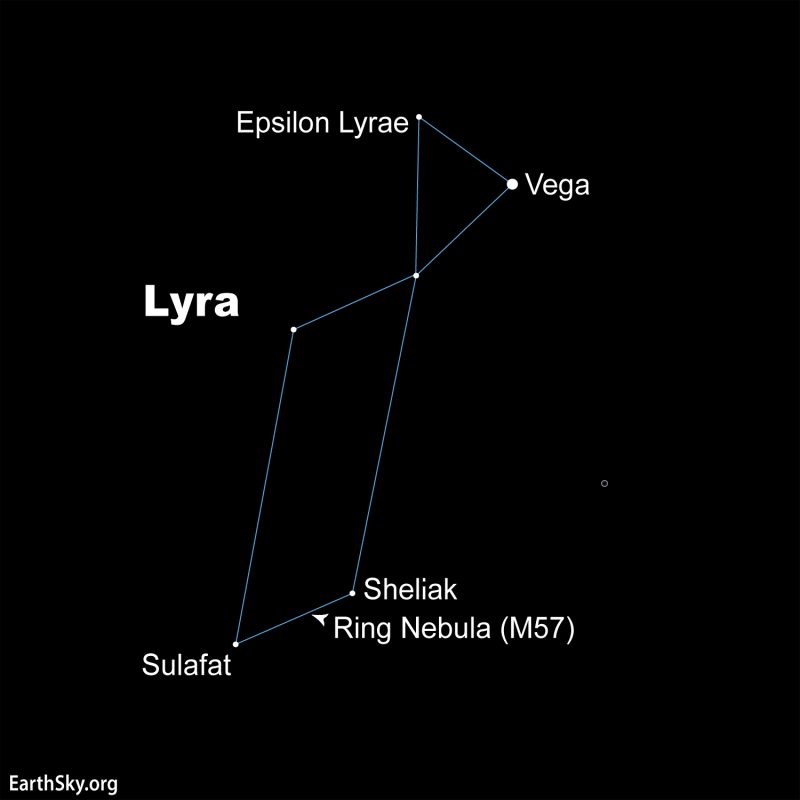
The constellation Lyra the Harp is made of a triangle and a parallelogram. Its brightest star is Vega. Next to it, look for Epsilon Lyrae, the famous Double Double star. Chart via EarthSky.
Cygnus the Swan
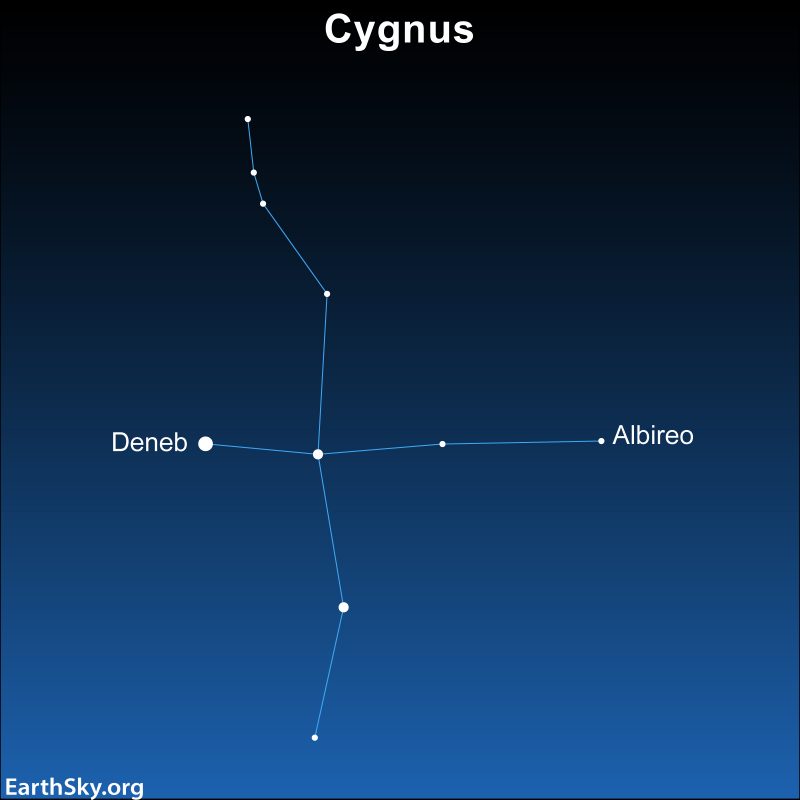
Cygnus the Swan’s brightest star, Deneb, marks one of the corners of the Summer Triangle. And its bright double star, Albireo, is one of the finest in the heavens.
Have fun exploring the sky!
Sky dome map for visible planets and the night sky
Here is the sky dome view for July 2026. It shows what is above the horizon at mid-evening for mid-northern latitudes. The view may vary depending on your location. Image via Guy Ottewell’s 2026 Astronomical Calendar. 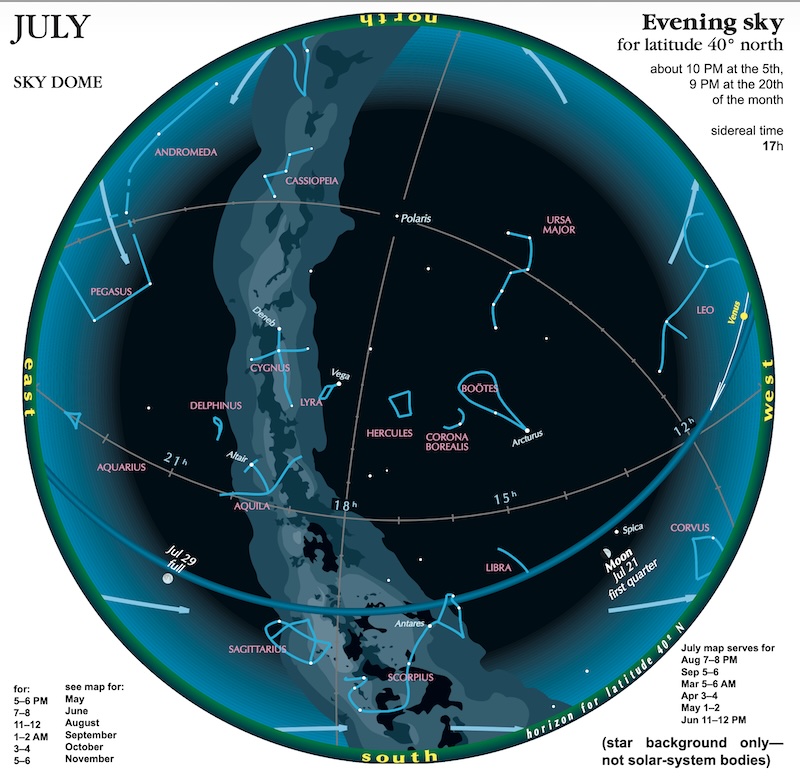
Heliocentric solar system, visible planets, and more
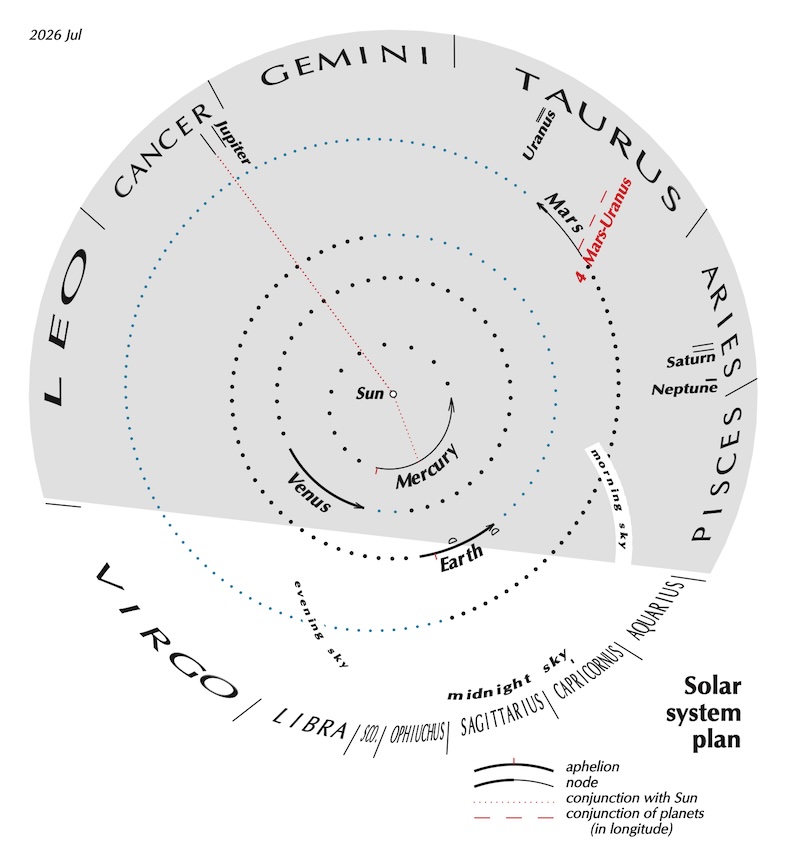
Heliocentric view of the solar system, July 2026. Chart via Guy Ottewell’s 2026 Astronomical Calendar. Used with permission. Plus Guy Ottewell explains heliocentric charts here.
Bottom line: EarthSky’s visible planets and night sky guide. On July 6, the Earth is farthest in its orbit from the sun.
Originally published by EarthSky.