
Venus brightest in the morning? Now’s the time
This month — due to the steep morning angle of the ecliptic for Northern Hemisphere skywatchers — Venus has shot like a rocket into our eastern, predawn sky. It’s well above our horizons, blazing like a beacon, this week! You can’t miss it before sunrise. Venus always outshines all other objects in our sky, except the sun and moon. But — for all observers around the globe — it’s brightest for 2026 in late November, before dawn.
Venus won’t appear this bright again in the evening sky until April 2028. It won’t appear this bright in the morning sky until July 2028. So look for Venus this week!
This inner world passed between us and the sun on October 23-24, 2026. That’s called an inferior conjunction of Venus. At such times, Earth (3rd planet outward from the sun), Venus (2nd planet) and the sun itself make a line in space — with Venus in the middle. And now Venus is pulling ahead of Earth in its smaller, faster orbit around the sun. Whenever that happens — about five weeks after (and before) inferior conjunction — Venus shines at greatest brilliancy in our sky. Greatest brilliancy for Venus in the morning sky will fall on November 29, 2026.
How bright is Venus now?
Venus is always the brightest planet. But it’s especially blazing around now. It’ll reach its maximum brightness at 14 UTC on November 29. Then it’ll shine at magnitude -4.4. That’s much, much brighter than any star.
Venus is so bright now that — if you look carefully — you can see it in the daytime. Want to learn how? See this article: How to see Venus in the daytime.
Venus reached another peak brilliancy — in the evening sky — on September 18, 2026. That was about five weeks before it dropped into the sunset glare prior to inferior conjunction. Around September 18, Venus was brighter than it had been for all of 2026. At magnitude -4.8, it was brighter than it will be at this November greatest brilliancy. But perhaps not noticeably brighter!
The fact is, Venus is always blazing at greatest brilliancy! Sometimes it’s also low in the sky, giving it an eerie appearance. That’s the case this month for observers in Earth’s Southern Hemisphere.
For all of us around the world, UFO reports are likely to increase in late November and early December, 2026! But you’ll know better. It’s not a UFO in the eastern morning twilight. It’s Venus, 2nd planet from the sun.
Why does Venus look brightest?
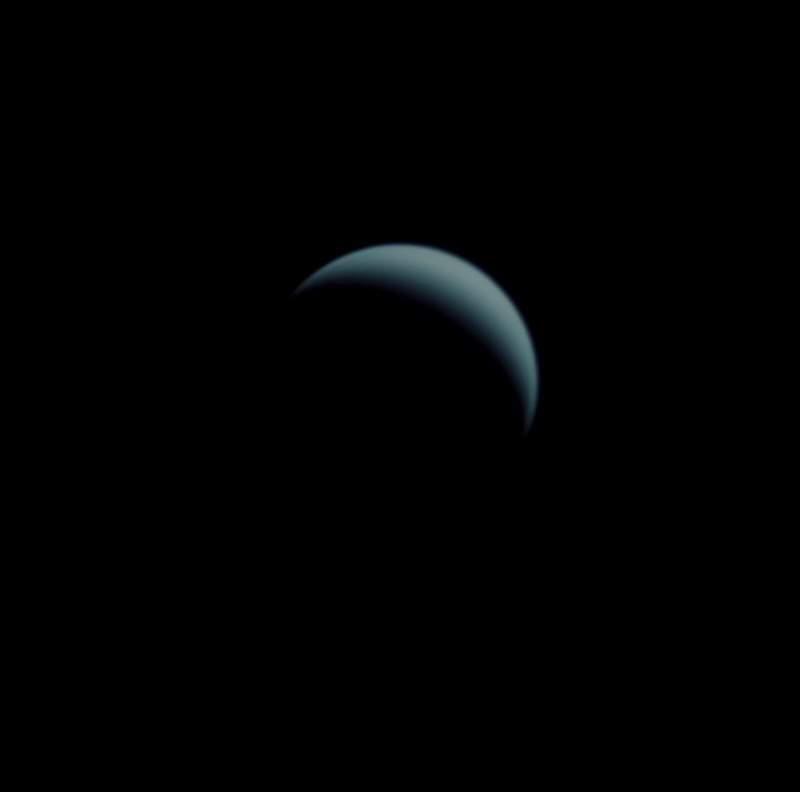
If you saw Venus through a telescope now, you’d find it in a crescent phase. And it’s only when we see Venus as a crescent that this world comes close enough to us to appear brightest in our sky.
Greatest brilliancy for Venus is a combination of two factors: Venus’ disk size in our sky, and its phase in our sky.
Venus was at superior conjunction – on the opposite side of the sun from Earth – on January 6, 2026. At superior conjunction, when Venus is on the far side of the sun from us, we see it at its full phase. But, at such times, Venus is far across the solar system from us. So its disk size is small as seen from Earth.
And that’s why you sometimes hear the term greatest illuminated extent for Venus at greatest brilliancy. The combination of a relatively large disk size — with a phase that’s not too small — is what gives Venus its incredible brightness in our sky at greatest brilliancy.
Disk size. If you could see Venus through a telescope now, you’d find the planet as a relatively large disk (around 40 arcseconds). That’s because it just passed between us and the sun. So it’s still relatively close to us now.
Phase. The absolute thinnest phase of Venus happened when it went between us and the sun on October 23-24. Then its day side was almost entirely turned away from us. Why almost? It’s because Venus rarely goes exactly between us and the sun. Such events are called transits of Venus. The next one won’t be until December 10-11, 2117!
Afer inferior conjunciton, the phase of Venus increases steadily. It looks through a telescope like a tiny waxing crescent moon. We are seeing more and more of its day side as it flees ahead of us i norbit around the sun.
So its disk is still relatively large, because it’s still relatively close to us. And its phase is larger than when it was between us and the sun. Voila! Greatest brillinacy.
As the weeks and months pass, Venus’ phase will increase. But its disk size will shrink. So it’ll appear fainter in our sky. But it’ll still be the brightest planet!
A thin blue crescent pointing upward.
View at EarthSky Community Photos. | Venus will be at its greatest illuminated extent, aka its greatest brilliancy, on and around November 29, 2026. Then it’ll be shining in your morning sky at magnitude -4.4. That’s super bright! Our friend Eliot Herman of Tucson, Arizona, contributed this photo in 2025, at that year’s greatest brilliancy of Venus, to show why it’s happening. That is, Venus is now at that magical place in its orbit around the sun where it just recently went between the Earth and sun. That inferior conjunction of Venus happened on October 23-24, 2026. So, right now, it’s relatively near Earth, and its disk appears large through telescopes. Meanwhile, we’re also still seeing a fairly large fraction of its day side. It’s that combination — relative nearness and relatively big crescent — that makes Venus brightest in our sky! No matter where you are on Earth, watch for Venus as the blazing object in the east before sunrise.
Venus charts for 2026, from Guy Ottewell

Venus’ greatest morning elongation in 2026-2027 from the Northern Hemisphere as viewed through a powerful telescope. The planet images are at the 1st, 11th, and 21st of each month. Dots show the actual positions of Venus every day. Chart via Guy Ottewell’s 2026 Astronomical Calendar. Used with permission.

Venus’ greatest morning elongation in 2026-2027 from the Southern Hemisphere as viewed through a powerful telescope. The planet images are at the 1st, 11th, and 21st of each month. Dots show the actual positions of Venus every day. Chart via Guy Ottewell’s 2026 Astronomical Calendar. Used with permission.
Venus photos from our community
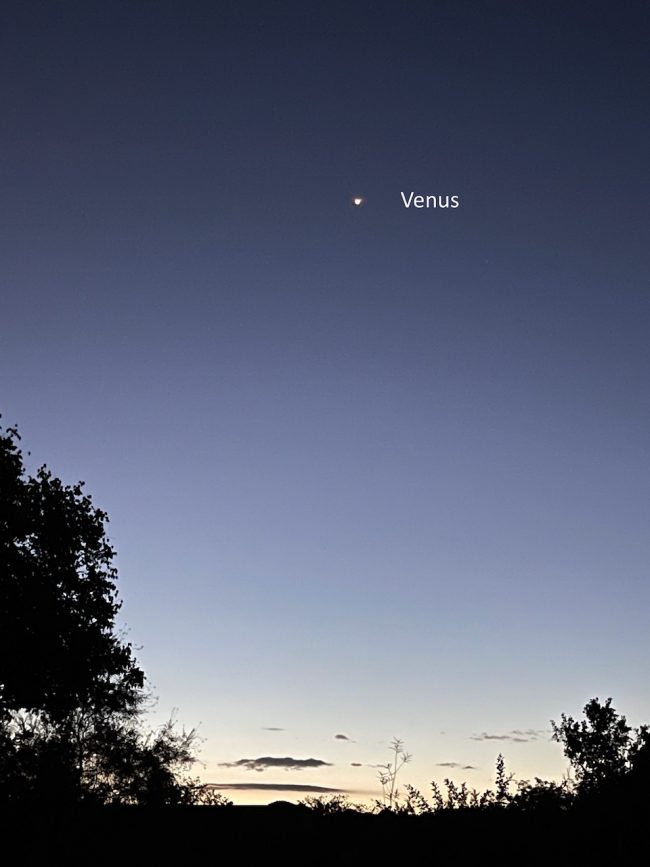
View at EarthSky Community Photos. | EarthSky’s Deborah Byrd caught Venus with an iPhone over the desert west of Santa Fe, New Mexico, on September 14, 2023. It was super bright! It’s easy to see, even from cities.
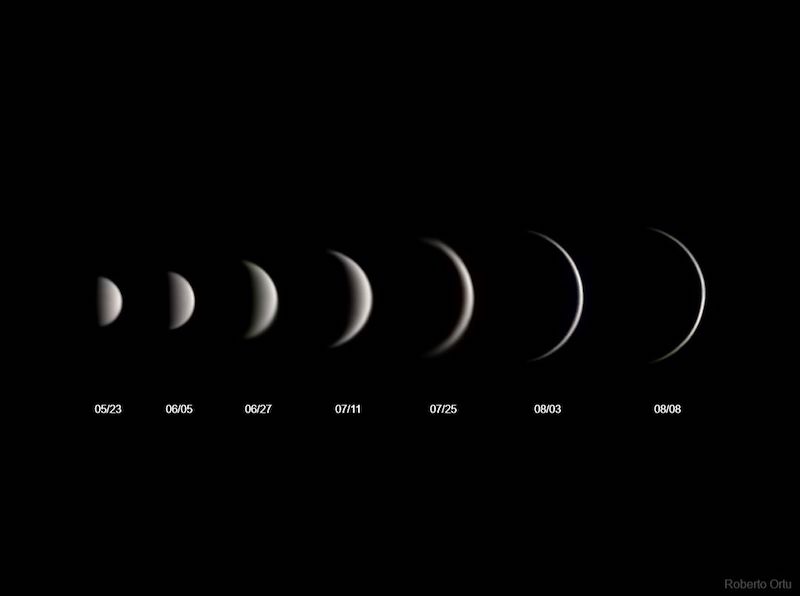
View at EarthSky Community Photos. | Roberto Ortu of Cabras, Sardinia, Italy, captured these images of Venus and wrote: “This is a mosaic with the best photos of the planet that I got from May 23, 2023, until August 8, 2023. The images show its phases, very similar to those of the moon, and the increase in its apparent diameter caused by the approach to the Earth.” Thank you, Roberto!

View at EarthSky Community Photos. | P Govardhana Siddartha of India submitted this composite image of Venus taken over 4 months. Venus was recorded from December 2024 to March 2025 as it raced toward inferior conjunction. You can see how the size of Venus increased and the phase decreased during that time. Thank you, P Govardhana!
Bottom line: Venus will be brightest in the morning sky around November 29, 2026. After that, Venus will next be at its brightest again — this time in the evening sky — in April 2028.
Originally published by EarthSky.