
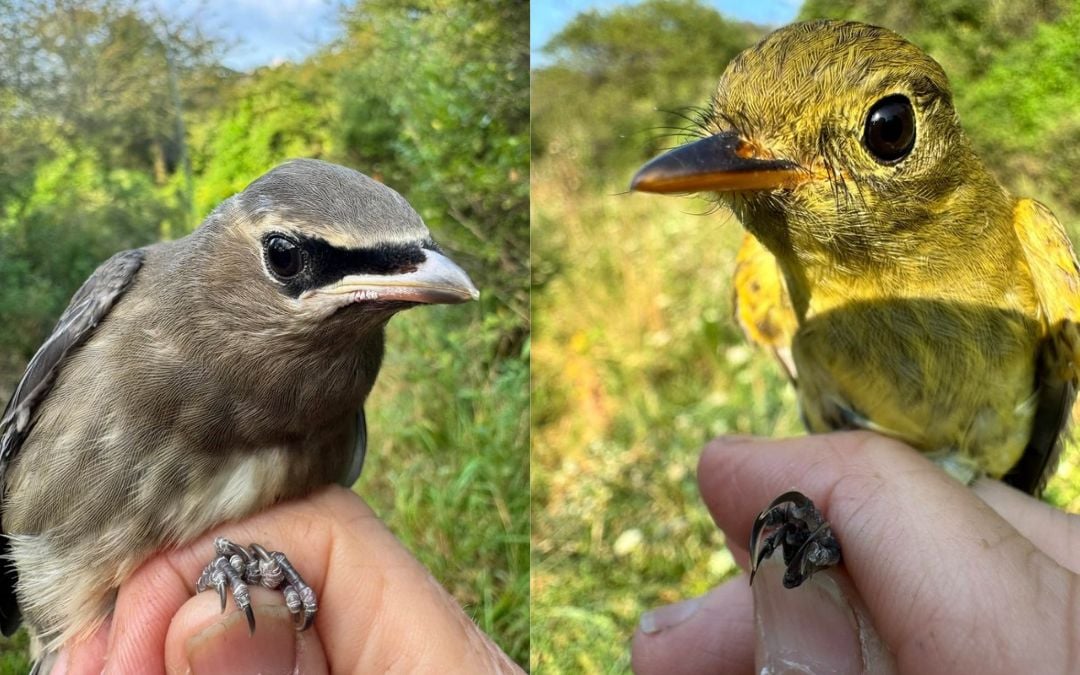
Did you know there is a group of volunteers banding birds each year in our community?
On a busy morning, Barbara and Duane Bailey, and the team might band 40 to 60 birds. On a slow one, Barb said, they barely reach double digits. Either way, each bird leaves with a small aluminum band on its leg and a unique number that may one day tell scientists where it has been.
The 2026 season recently wrapped up, and Barbara shared some of the season’s photos, a few of which appear here. The list of visitors reads like a field guide: Scarlet Tanager, Common Yellowthroat, American Woodcock, Ovenbird, Black-throated Blue and Black-throated Green Warblers, Red-eyed and White-eyed Vireos, Cedar Waxwing, Northern Parula, Indigo Bunting, Golden-crowned Kinglet, Purple Finch, Northern Flicker, Bay-breasted Warbler, Winter Wren, Cape May Warbler, Yellow-bellied Sapsucker, Field Sparrow, Tennessee Warbler and Palm Warbler, among many others.
The local station runs about 20 mist nets. These are fine, nearly invisible mesh nets strung between poles along woodland edges and brushy areas where birds naturally travel. A bird that flies into the net drops into a loose pocket of mesh and stays there until a bander removes it. The nets stay open for about five hours each morning, and birds are taken out quickly. “They are never more than a very short time in the nets,” Barbara said.
Once a bird is gently freed, it’s placed in a small cloth bag, which helps keep it calm on the way to the banding table. There, a lightweight band sized for that species is closed loosely around the lower leg. The band can move freely but won’t slip off.
Each number is issued by the federal Bird Banding Lab, part of the U.S. Geological Survey. All birds at the station are captured and banded under a federal permit.
Before release, each bird is identified and measured. Banders typically record species, age, sex, wing length, weight and fat reserves, which show how well a bird is prepared for migration. The process takes only a few minutes.
All of that information goes into a national database that the Bird Banding Lab has kept for more than a century. Banding records have shaped much of what is known about migration: the routes birds follow, when they travel, and where they stop to rest and refuel.
I have invited myself to go out on a bird-banding adventure with the group next summer. Stay tuned!
From the November Issue of the Lakefront Magazine.