
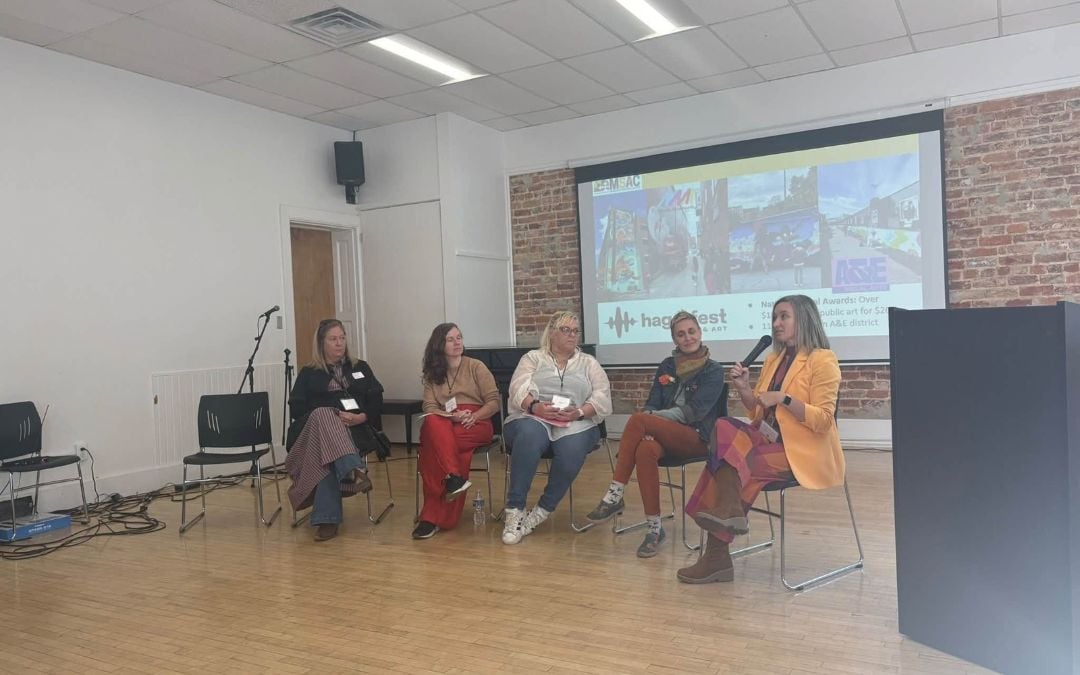
At the end of September, Frederick, Maryland, provided an inspiring setting for the one-day state A&E Convening, bringing together arts leaders and coordinators to explore how arts and culture can shape vibrant, connected communities. Representing Western Maryland, Oakland and Grantsville A&E Coordinators Emily Elmlinger and Maureen Sheaffer, along with Garrett County Arts Council Executive Director Kathy Beachler, attended the event. Elmlinger and Beachler were also part of a small group that presented at the event, sharing insights into fundraising strategies and the challenges of securing the significant financial resources needed to sustain arts and entertainment programs in rural communities.
The convening offered an opportunity to exchange ideas, learn from fellow arts professionals, and explore creative approaches to strengthening local arts districts. Frederick’s historic downtown, colorful public art, welcoming green spaces, and commitment to creative placemaking provided an engaging backdrop for these conversations.
A highlight of the event was a tour of Frederick’s Arts & Entertainment (A&E) District, where creativity is woven into the fabric of downtown. The district’s historic streets offer more than charming architecture and locally owned businesses; they reveal a community that embraces art as an essential part of its identity.
Participants experienced public art murals painted across building walls, weaving the city’s history into the fabric of the buildings and open spaces. These large-scale works bring color, personality, and meaning to the streetscape, inviting residents and visitors to experience and explore the rich history of Frederick through art.
The downtown tour also showcased art installations that encourage interaction. From unexpected artistic details along pedestrian routes, such as a bike rack that spell “Frederick” using American Sign Language, incorporating access for the hearing impaired into functional pieces that truly show how art can be inclusive, these installations demonstrate how art can make shared spaces more engaging. They also illustrate how a thoughtfully developed A&E District can support local artists, attract visitors, strengthen neighborhood identity, and create opportunities for people to connect with their surroundings.
Beyond downtown’s streets and buildings, Frederick’s public spaces offered another perspective on the relationship between art, nature, and community. The group explored a public park that serves as both a recreational destination and a cultural gathering place. With areas designed to accommodate concerts and other community activities, the park provides an inviting setting where people can come together to enjoy music at the very popular Alive @ Five event at the Carroll Creek Amphitheatre that has become a tradition for locals and visitors and serves the dual purpose of providing entertainment and a place to gather as a community and raising much-needed funds for the Frederick A&E and the other events they sponsor.
Along Carroll Creek, kinetic art sculptures have been installed in the creek itself and provide movement and artistic expression into the natural environment. Their placement demonstrates how public art can extend beyond traditional galleries and plazas, creating experiences that are accessible, surprising, and connected to the character of a particular place.
For Elmlinger, Sheaffer, and Beachler, the convening also provided an opportunity to reflect on the unique challenges facing arts organizations in rural areas. During their presentation, Elmlinger and Beachler discussed fundraising strategies and the difficulties of raising the substantial funds required to operate A&E programs. While these programs contribute to community identity, tourism, and economic vitality, securing consistent financial support can be especially challenging in rural communities with smaller populations and limited funding resources.
Frederick’s combination of historic character, contemporary public art, and lively outdoor spaces demonstrated how creativity can animate a community. For the Garrett County representatives, the one-day A&E Convening was an opportunity to gather inspiration, share rural perspectives, and bring fresh ideas home. From murals transforming downtown walls to kinetic sculptures moving within a local creek, the experience highlighted the power of art to connect people, place, and possibility.
Written by the Garrett County Arts Council.
From the November issue of the Lakefront Magazine.