




Originally published by Sea and Sky.
August 2: Mercury at Greatest Western Elongation. The planet Mercury reaches greatest western elongation of 19.5 degrees from the Sun. This is the best time to view Mercury since it will be at its highest point above the horizon in the morning sky. Look for the planet low in the eastern sky just before sunrise.
August 12: New Moon. The Moon will located on the same side of the Earth as the Sun and will not be visible in the night sky. This phase occurs at 17:37 UTC. This is the best time of the month to observe faint objects such as galaxies and star clusters because there is no moonlight to interfere.
August 12: Total Solar Eclipse. A total solar eclipse occurs when the moon completely blocks the Sun, revealing the Sun’s beautiful outer atmosphere known as the corona. The path of totality will begin in the Arctic Ocean off the Northern coast of Russia. It will move across Greenland, Iceland, and the Atlantic Ocean before ending in Spain. A partial eclipse will be visible Alaska, Canada, western Africa, and the northern United States.
(NASA Map and Eclipse Information) (NASA Interactive Google Map)
August 12, 13: Perseids Meteor Shower. The Perseids is one of the best meteor showers to observe, producing up to 60 meteors per hour at its peak. It is produced by comet Swift-Tuttle, which was discovered in 1862. The Perseids are famous for producing a large number of bright meteors. The shower runs annually from July 17 to August 24. It peaks this year on the night of August 12 and the morning of August 13. This is an excellent year for the Perseids. There will be no moonlight to interfere with the show so be prepared for what could be an impressive display. Best viewing will be from a dark location after midnight. Meteors will radiate from the constellation Perseus, but can appear anywhere in the sky.
August 15: Venus at Greatest Eastern Elongation. The planet Venus reaches greatest eastern elongation of 45.9 degrees from the Sun. This is the best time to view Venus since it will be at its highest point above the horizon in the evening sky. Look for the bright planet in the western sky after sunset.
August 28: Full Moon. The Moon will be located on the opposite side of the Earth as the Sun and its face will be will be fully illuminated. This phase occurs at 04:19 UTC. This full moon was known by early Native American tribes as the Sturgeon Moon because the large sturgeon fish of the Great Lakes and other major lakes were more easily caught at this time of year. This moon has also been known as the Green Corn Moon and the Grain Moon.
August 28: Partial Lunar Eclipse. A partial lunar eclipse occurs when the Moon passes through the Earth’s partial shadow, or penumbra, and only a portion of it passes through the darkest shadow, or umbra. During this type of eclipse, a part of the Moon will darken as it moves through the Earth’s shadow. The eclipse will be visible throughout most of North America, Mexico, Central America, South America, the Atlantic Ocean, and most of Europe and Africa.
Visible Planets and Night Sky Guide for July
June 6, Earth will reach its farthest point from the sun in its orbit. But it’s summer in the Northern Hemisphere! How can that be? Plus, a big asteroid passed close to Earth last last weekend. Should we worry? July 6: Earth at aphelion July evening planets: Northern Hemisphere view July morning planets: Northern Hemisphere view July 7: Watch for the 3rd quarter moon July 7 and 8 mornings: Moon near Saturn July 10 and 11 mornings: Moon near Aldebaran, Mars and the Pleiades...
June Solstice in 2026: All You Need to Know
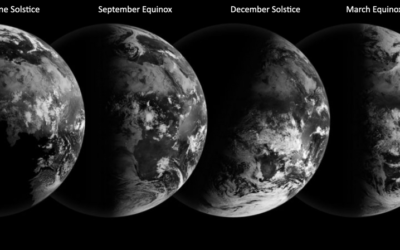
June Solstice in 2026 When is it? In 2026, the solstice moment will fall at 8:25 UTC (3:25 a.m. CDT) on June 21. What is it? At the June solstice, the sun reaches its northernmost point. This point is on the celestial Tropic of Cancer, a parallel around the sky, 23.5 degrees north of the celestial equator. At this solstice, the Northern Hemisphere is most tilted toward the sun, with a maximum angle of 23.5 degrees. Conversely, the south is most tilted away by the same amount. What are its main...
Visible Planets and Night Sky Guide for May 2026
May 1: Full Flower Moon lies between Antares and Spica Start watching Venus and Jupiter! Venus is the brightest planet in Earth’s sky. And Jupiter is the 2nd-brightest. About every 3 to 5 years, these 2 blazing worlds come together in Earth’s sky in a way that’s truly spectacular. They’re gearing up to do that now. Their conjunction will be around June 8 and 9. And, when closest, their distance on our sky’s dome will be roughly the width of your pinky finger held at arm’s length. Start...
Meteor Showers are Here! 10 Easy Tips for Watching
Hooray! It’s meteor time! That’s right, the Lyrid meteor shower rambles across for a few weeks around April 22. So, how can you optimize your chances of seeing a great meteor display? Follow the tips below. 1. Know the peak time Generally, meteor showers happen over many days as Earth encounters a wide stream of icy particles in space. These particles are debris left behind by a comet. So the peak is a point in time when Earth is expected to encounter the greatest number of comet particles....
Meteor Shower Guide 2026: Up Next … the Lyrids (April)
April 2026 meteors … the Lyrids When to watch in 2026: After midnight and through dawn on the morning of April 22. The predicted peak is 19:15 UTC on April 22. The peak of the Lyrids is narrow (no weeks-long stretches of meteor-watching, as with some showers). In 2026, the first quarter moon falls at 2:32 UTC on April 24. So, meteor watching after midnight and before dawn on April 22 will be under a dark and moonless sky. Radiant: Rises before midnight, highest in the sky at dawn. Nearest moon...
Rocket Launches can sometimes be seen in Garrett County. Especially those from Wallops Island.