
April 2026 meteors … the Lyrids
When to watch in 2026: After midnight and through dawn on the morning of April 22. The predicted peak is 19:15 UTC on April 22. The peak of the Lyrids is narrow (no weeks-long stretches of meteor-watching, as with some showers). In 2026, the first quarter moon falls at 2:32 UTC on April 24. So, meteor watching after midnight and before dawn on April 22 will be under a dark and moonless sky.
Radiant: Rises before midnight, highest in the sky at dawn.
Nearest moon phase: First quarter moon falls at 2:32 UTC on April 24. So a fat waxing crescent moon – that sets after midnight – won’t interfere with the peak morning of the 2026 Lyrid meteor shower. The best time to watch is after midnight and before dawn on the morning of April 22.
Duration of shower: April 15 to April 29. This time period is when we’re passing through the meteor stream in space!
Expected meteors at peak, under ideal conditions: In a dark sky with no moon, you might see 10 to 15 Lyrids per hour. The Lyrids are known for uncommon surges that can sometimes bring rates of up to 100 per hour! Lyrids are also known for their bright and colorful meteors, sometimes even producing fireballs. Fireballs are exceptionally bright meteors that outshine the planet, Venus.
Note for Southern Hemisphere: This shower’s radiant point is far to the north on the sky’s dome. So the Southern Hemisphere will see fewer Lyrid meteors. Still, you might see some!
Meteor train possibilities? In a moonless sky, a few Lyrid meteors can leave persistent trains. That is, they leave a trail of ionized gases that glow for a few seconds after the meteor has passed. Lyrids are known to produce fireballs.
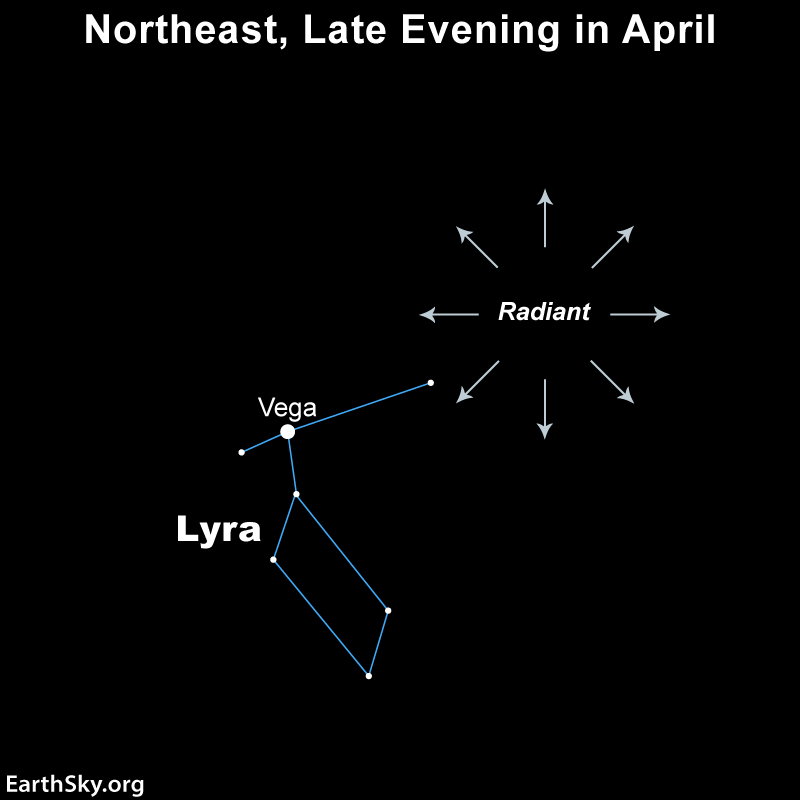
Lyrid meteors radiate from near the bright star Vega in the constellation Lyra the Harp. You don’t need to identify Vega or Lyra in order to watch the Lyrid meteor shower. But you do need to know when the radiant rises, in this case in the northeast before midnight. That’s why the Lyrids are typically best between midnight and dawn.\
May 2026 meteors … the Eta Aquariids
When to watch: The best morning to watch is May 5, 2026, in the hours before dawn. The American Meteor Society is listing 3:51 UTC on May 5 as the shower’s predicted peak time. The fact is that the peak of this shower stretches out over several days. So you can expect elevated numbers of meteors a few days before and after the peak time. The mornings of both May 4 and May 6 are also good times to watch!
Nearest moon phase: The last quarter moon will fall at 21:10 UTC on May 9. So, there will be a waning gibbous moon in the post-midnight sky that sets after sunrise. So the sky before dawn on the mornings around the predicted peak for the 2026 Eta Aquariids will compete with a bright gibbous moon. Find a way to block out the moon for a better view of the sky.
Radiant: will rise in the wee hours, climbing toward its highest point at dawn. That’s why the hours before dawn will be the best time to watch this shower.
Duration of shower: April 15 to May 27. This time period is when we’re passing through the Eta Aquariid meteor stream in space!
Expected meteors at peak, under ideal conditions: The zenithal hourly rate (ZHR) of this shower (the rate at the shower’s peak, under a dark sky, with no moon, when the radiant is high in the sky) is 60. In 2026, a waning gibbous moon will severely affect this shower, reducing hourly rates. And be aware that the shower is best for latitudes like those in the southern half of the U.S. or even farther south, in the Southern Hemisphere. These are swift meteors that produce a high percentage of persistent trains.
Note: The Eta Aquariids’ radiant will be on the ecliptic, which will ride low in the sky on spring mornings as seen from far northerly latitudes. This shower favors more southerly latitudes (like those in the southern U.S. or the Southern Hemisphere), where the radiant appears higher in the morning sky. It’s often the Southern Hemisphere’s best meteor shower of the year.
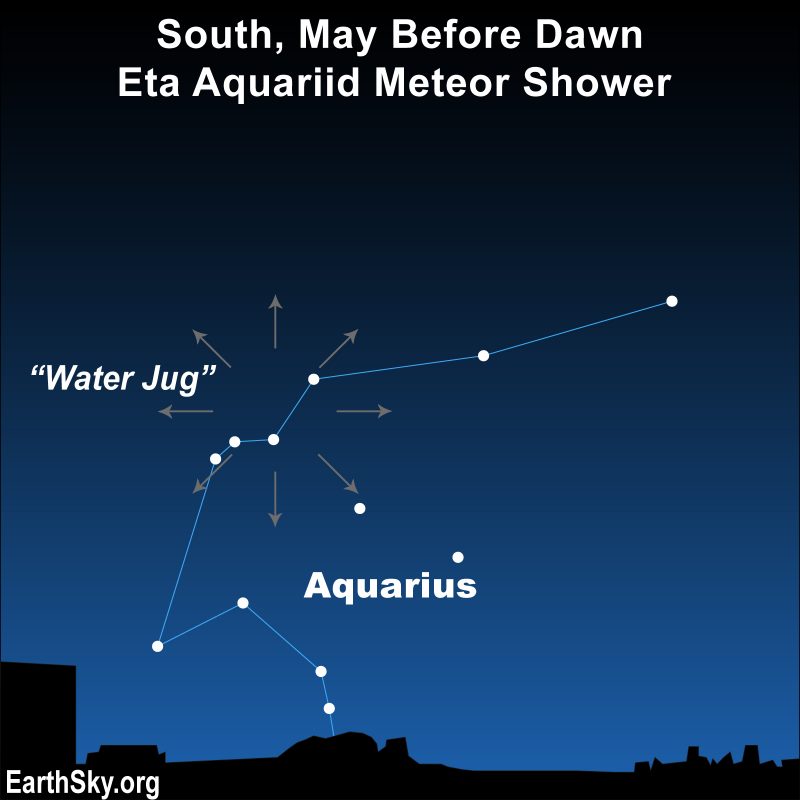
The radiant point of the Eta Aquariid meteor shower will be near the star Eta Aquarii in the constellation Aquarius the Water Bearer. The radiant will rise in the wee hours after midnight and will continue climbing toward its highest point at dawn. That highest point will be in the south as viewed from the Northern Hemisphere, closer to overhead for the Southern Hemisphere. That’s why the Southern Hemisphere will see more meteors (the radiant will be higher up), and it’s why – for all of us around the globe – the hours before dawn will be best for this shower.
June 2026 daytime meteor shower … the Arietids
Most meteor showers are easy to observe. Just find a dark sky, and look up! But what about meteor showers that happen in the daytime, when the sun is up? The Arietids are sometimes said to be the most active daytime meteor shower. In 2026, their predicted peak will be around the morning of June 10. You might catch some Arietids around that morning in the dark hour before dawn.
When to watch: Watch from May 22 to July 3. There’s a predicted peak for the mornings around June 10, 2026. Watch for them in the sunrise direction in the dark hour before dawn breaks.
Nearest moon phase: In 2026, a 3rd quarter moon occurs at 10:00 UTC on June 8. So on the mornings around June 10, a thick waxing crescent moon will interfere with watching for meteors. Watch from a place that’s in the moon’s shadow or find a distant object to block out the light of the moon.
Radiant: The shower’s radiant point – the point in the sky from which the meteors appear to radiate – is in the constellation Aries. You’ll find this constellation in the east before sunrise.
Duration of shower: May 22 to July 3.
Expected meteors at peak: This is tricky for daytime meteor showers because once the sun comes up, you won’t be able to see them. But the Arietids have a strong zenithal hourly rate (ZHR)! Meteor counts with radar and radio echoes have indicated a rate of 60 meteors per hour, and perhaps as high as 200 meteors per hour.
Note: The Arietids are sometimes said to be the most active daytime meteor shower.
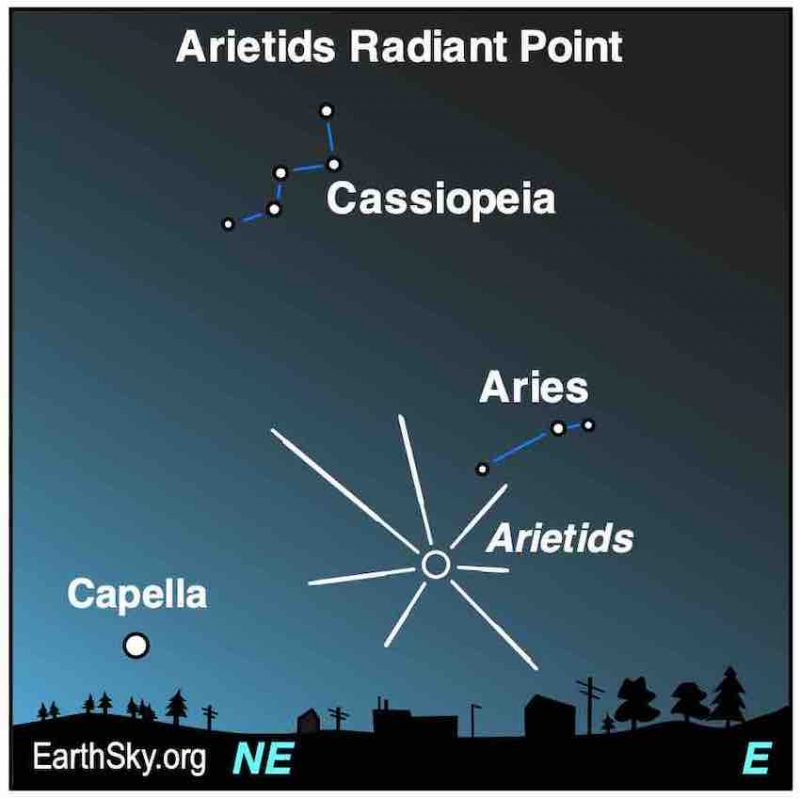
The Arietids are an active shower, but they’re visible mostly in daytime. Watch for them in the sunrise direction in the dark hour before dawn from May 22 to July 3. You’ll be looking for meteors that shoot up from the horizon. The radiant is below the constellation Aries the Ram. Chart by EarthSky.
Meteor shower words of wisdom
A wise person once said that meteor showers are like fishing. You go, you enjoy nature … and sometimes you catch something.
Bottom line: Up next is the Lyrid meteor shower, they’ll be best after midnight and before dawn on April 22. And good news, they will be under a dark and moonless sky.
**Peak times for meteor showers provided by Robert Lunsford of the American Meteor Society. Note that predictions for meteor shower peak times may vary.
Originally published by EarthSky.