
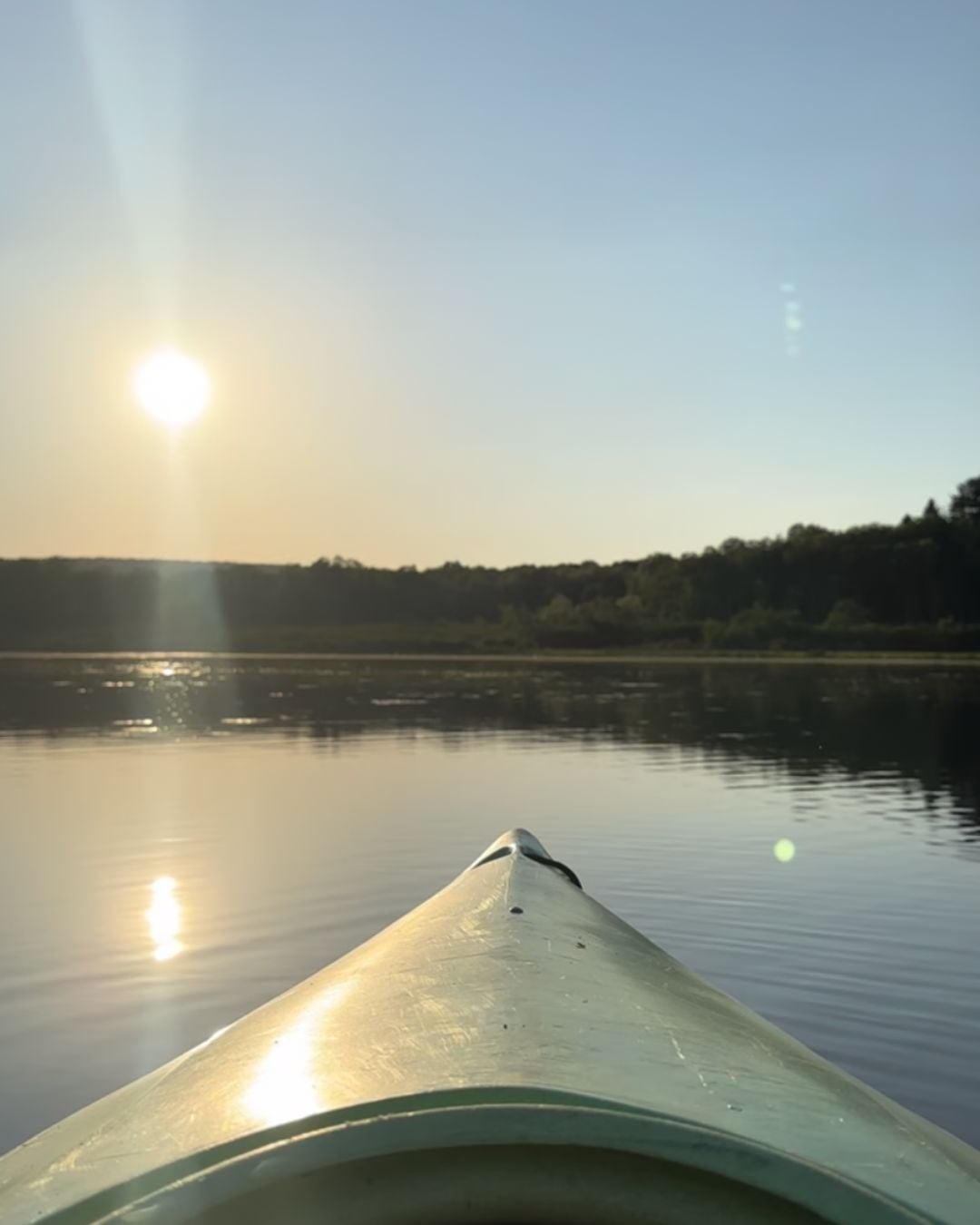
As the weather warms, you’ll see kayaks all around DCL. Some will be solo, while others will form up like a gaggle of geese. Some will pass by slowly, and others look like wind turbines in a storm.
But kayaking didn’t start here. So, where did it start? Like most things “lost to history,” it’s a matter of guessing. Best guess: the kayak was created by the Inuit, Yupik, and Aleut tribes, living in the Arctic areas of North America at least 4000 years ago. They used the kayak to hunt seals and walruses. These original kayaks had a frame of driftwood or whale bones, wrapped with seal skin and coated with whale fat to keep them watertight. I’ll bet you could smell them before they came into view.
Although Garrett County was never home to seals and walruses, we can still claim something of kayak interest: the 1989 Canoe/Kayak World Championship. Our nearby Savage River was selected for this event because the river flow is controlled by the release of the dam that holds back the Savage River Reservoir. The water release can create a Class V whitewater, which is exactly what was needed for the race event.
According to Paddling.com, Class V is “Extremely difficult. Long and violent rapids that follow each other almost without interruption. River filled with obstructions. Big drops and violent currents. Extremely steep gradient. Even reconnoitering may be difficult. Rescue preparations mandatory. Can be run only by top experts in specially equipped whitewater canoes, decked craft, and kayaks.” Clearly, not a place for a Sunday afternoon picnic float. You can watch a YouTube video of the 1989 race online on YouTube.
If you’re interested in something a little more challenging than flat-water kayaking on DCL, how about something 620 feet higher in elevation? Parachute-kayaking? Nope. The Adventure Sports Center International, an Olympic-standard whitewater rafting and canoe/kayak slalom center, is located on the mountaintop above the Wisp Ski Resort. How could this be?
The concept took form after the 1989 Whitewater Slalom World Championships on the Savage River. Sergi Orsi, president of the International Canoe Federation, encouraged the organizers to build a pump-powered, artificial whitewater course in a more accessible nearby location. Since the Wisp Ski Resort already had a pump-filled mountaintop reservoir to supply its snowmaking machines, the artificial whitewater course was sited beside the reservoir to make use of its water in the summer. Pretty slick, no? Recycling the water meant there was no dependence on summer rain.
The center opened in May 2007, constructed at a cost of $24 million, and is the third pump-powered artificial whitewater facility built in North America. In addition to serving as a venue for slalom races and training, the center offered a range of services to the general public, including guided raft trips, inflatable kayak rentals, and riverboard rentals. Currently, the previous operator has ceased operations for the public. Perhaps it will come back under another manager…
The Center’s educational partner in water sports instruction is the Adventuresports Institute of Garrett College, which offers degrees in outdoor adventure sports. These specialties include outdoor guide, outdoor education, wilderness therapy field instructor, adaptive recreation facilitator, ski industry professional, climbing ranger, river patrol ranger, backcountry ranger, and many other outdoor industry certifications leading to employment.
Just as there are many automobile styles, shapes, and sizes, there are many kayak types to choose from. Some are built for flatwater, others are built for whitewater, and others for long-distance kayak camping. Some are designed for one person, some for two, often referred to as “tandem”. Sit-upon versus sit-in styles each have their advantages. Plastic is a popular low-cost material, while carbon fiber kayaks might set you back $5,000.
Whichever you choose, safety should be your first consideration. Every local kayak rental will give you a personal flotation device (pdf). Wear it. Don’t sit on it, wear it. Don’t put it inside the kayak; wear it. Don’t put it behind your back; wear it. Wear it.
DCL is a large lake. Large lakes have big boats. Big boats go fast. Often, big boats are towing something, like kids on a raft. The pilot is watching for them, not for you. You’re sitting low on the water and will be difficult to see. So, what’s the solution? Stay away from where the big boats run, the center of the lake. Besides, there’s nothing to see that far out. Stay close to shore. In four feet of water, you’ll be able to see the bottom. Not so in 20 feet of depth. And, you’ll be able to stand on the bottom if you fall out into four feet of DCL.
There’s yet another mid-lake threat you need to consider – jet skis. These are often piloted by people only interested in speed and without concern for other craft, like kayaks. Do yourself a favor and stay close to shore. There will be more to see and fewer threats to life and limb. As a general rule, if you can’t see the lake bottom, you’re out too far.
A place to launch a kayak should be selected carefully. Don’t trespass on private property. Unposted shorefront is in limited supply on DCL, so do your best to avoid a conversation with local law enforcement.
Consider launching in one of the several bays and tributaries to DCL. An advantage is that bigger boats and jet skis can’t safely use these areas, so you’ll have them all to yourself.
If the wind is too heavy, most rental places will not allow you to take a kayak. If there’s a breeze, try taking a small umbrella with you. A small one,
not one of those 10-foot diameter beach umbrellas. Best of all is a see-through umbrella. Start your trip by paddling into the breeze. When you’re ready to turn around and return, open the umbrella and let the breeze provide the power. You’ll experience a new definition of wind power. If the umbrella is not to your liking, you could add a kayak sail, most of which have a window for safety considerations. They start around $25 for simple rigs and run up to $200 for more complicated sails.
Local rental sources. If you’re looking for a quiet time on the water, there are several nearby shops to choose from.
High Mountain Sports (highmountainsports.com) (301) 387-4199, 21327 Garrett Hwy, Oakland has 30 single kayaks and 30 two-person kayaks available by the hour or on a long-term basis. They also have a delivery option for people who are staying on the lake and want to have a kayak delivered. This is a multi-day option, and reservations are required in advance. In addition to wearing a personal flotation device, you must be able to swim. Advice for new kayakers – start out paddling into the wind.
Aquatic Center (aquatic-center.com), (301) 387-8233, 634 Deep Creek Drive, McHenry, offers single and double kayaks by the hour and by the day. Delivery service is available for those staying around DCL. The minimum age for rentals is 18, although children under 18 can ride in a kayak with a parent, but the child must be able to swim. Advice for new kayakers – stay in shallow water.
Fun Time Watersports (funtimewatersports.com), (301) 387-0725, 20294 Garrett Hwy, Oakland, has 7 kayaks available for rent on an hourly basis. Minimum age is 16 for a solo kayak rental. Younger children are allowed as long as they are accompanied by an adult. Advice for new kayakers – stay close to shore and avoid the middle of the lake.
In closing, this quote from Nouria Newman, a French professional whitewater kayaker, “Do it because it’s fun and because you love it.”
Written by Tony Lolli.
From the June issue of the Lakefront Magazine