
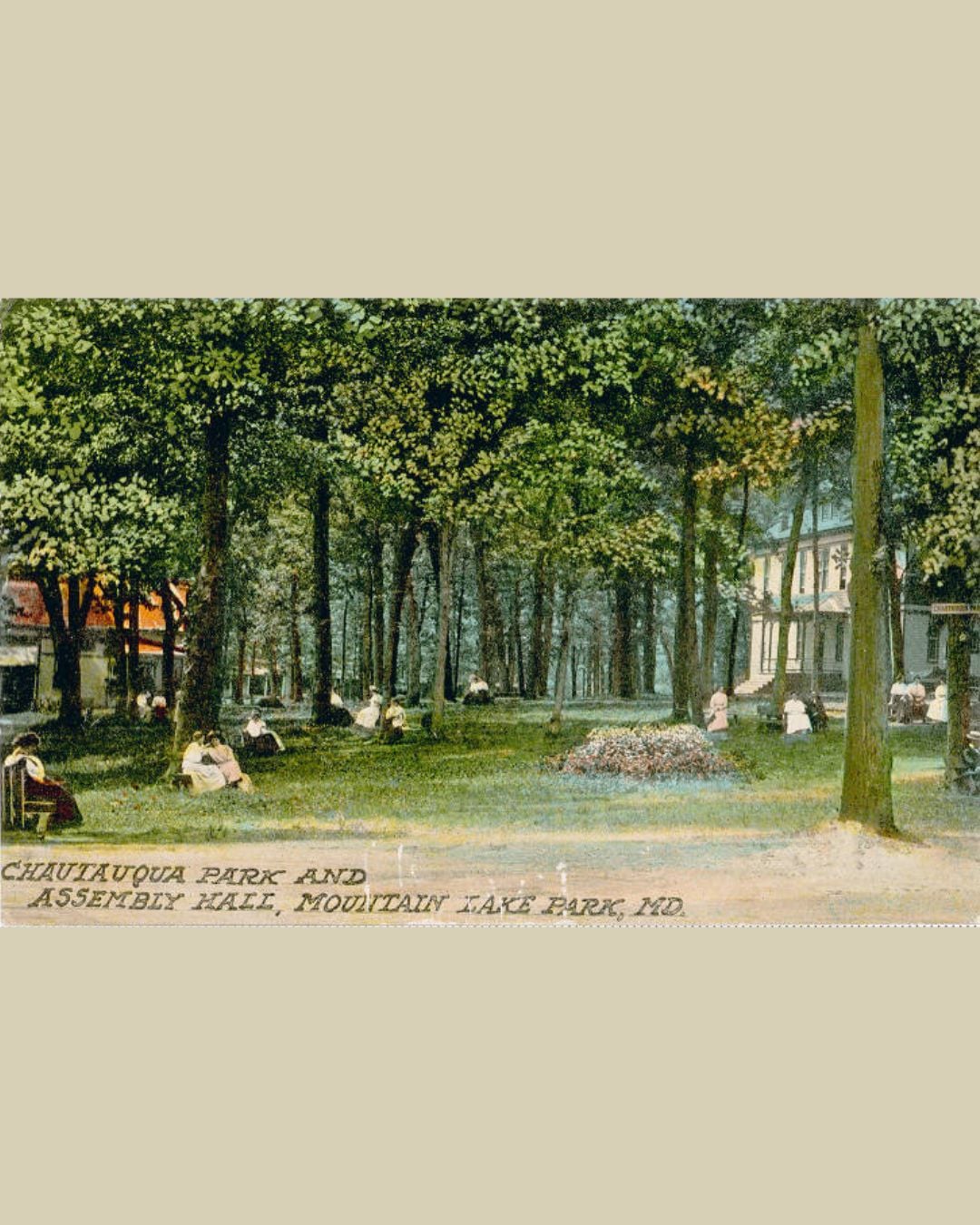
In conjunction with Garrett County’s 250th anniversary, let’s reminisce and take a look at Mountain Lake Park, which was established in 1881, making it a little bit younger at 145.
On September 3, 1881, 5 businessmen rode through “Hoyes Big Pasture,” now known as Mountain Lake Park, looking for suitable grounds to establish a Summer Resort founded upon Christian principles and designed to afford opportunities for Religious and Literary Instruction and healthful recreation.
In 1881, Mountain Lake Park was purchased as 800 acres for the sum of $4,672. Today the town has expanded to 1280 acres with an assessed value of over $100,000,000. One of the first buildings to be built was the Assembly Hall located on five acres.
November 1, 1881, the Baltimore and Ohio Railroad ran an excursion to Mountain Lake Park, and a public sale of lots was held. A good number of lots were sold. Town lots sold for $300 each.
The lake was developed shortly after the town’s founding in 1881 to serve as a centerpiece for the Mountain Chautauqua, a popular Victorian-era resort. The dam was constructed to create the lake for recreation through the summer months and for ice harvests for the B&O dining cars in the cold season.
In 1908, the Mountain Lake Park Tennis Club was established on the grounds adjacent to the Clubhouse. Three courts were available for play, including playing rules and fees. In 1911, it was decided that players would have to sign up in advance, wear tennis shoes, and were not allowed to play on Sundays. One set of tennis cost 10 cents, three sets for 25 cents, 15 sets for $1.00, and $2.50 for a season pass.
Today, the historic Mountain Lake Park Tennis Club is located at 1007 Allegheny Drive. This facility features four outdoor red clay courts that are open to the public and offer instruction and play opportunities for all skill levels. The club is known for having the oldest red clay courts in the state. The facility hosts an annual USTA-sanctioned tournament.
Mountain Lake Park was a thriving summer resort town, with private homes, boarding houses, cottages, many large hotels, the round open-air Bashford Amphitheater, which held up to 5,000 people, Mountain Lake with its ice house, boathouse, and livery.
The most noted speakers of America addressed capacity audiences from its spacious platform. It was also the setting for the Mountain Choir Festival from 1934 to 1941. A few of those notable guest lecturers in the Bashford Amphitheater were Mark Twain, William Jennings Bryan, and President Taft.
The Mountain Lake Park Historic District primarily features a unique blend of rural Victorian, Queen Anne, Gothic, and Colonial Revival homes. There are still 61 original structures remaining.
Today Mountain Lake Park is a thriving residential area with tennis courts, Broadford Lake Park, playgrounds, MLP Museum, historic Bethel Church, and the Mountain Lake Park Splash Pad. There are also businesses, churches, and schools.
The original resort association dissolved in 192; Mountain Lake Park was added in 1983 as a Historic District on the National Registry.
To celebrate Mountain Lake Park’s founding, the town hosts their Victorian Chautauqua event every year on the weekend following the 4th of July. The free event includes performances, lectures, live music, and activities that bring to life a bygone era that began as a planned community along the B&O Railroad. This year the event dates are July 11th-12th.
This event has grown over the years and is so much fun to attend. I grew up in Mountain Lake Park, and this event brings back so many memories. It’s not hard to picture the women in their long dresses and men in suits arriving by train to enjoy the fresh mountain air, and enjoy dining and social engagements in the big hotels. The lake and the boardwalks, the large wrap-around porches to sit and enjoy a leisurely summer. The summer houses built to “escape” the busy cities and study religion- what a wealth of history here!
I was fortunate enough to remember when there was water in the old lake. My parents, siblings, and I would go for walks to Crystal Spring; that cold, clear water always tasted extra special. We would fish in the lake, and seine for minnows over the spillway.
A summer resort town like many others that were opened up with the railways, but had a special mountain feel of purity and wellness. It’s not hard to look at the old restored homes and imagine what was!
Photo source: Western Maryland’s Historical Library – This image is part of the William Hollifield Collection, at the Maryland Historical Society, now The Maryland Center for History and Culture
Written By Robin Clutter.
From the July issue of the Lakefront Magazine.