
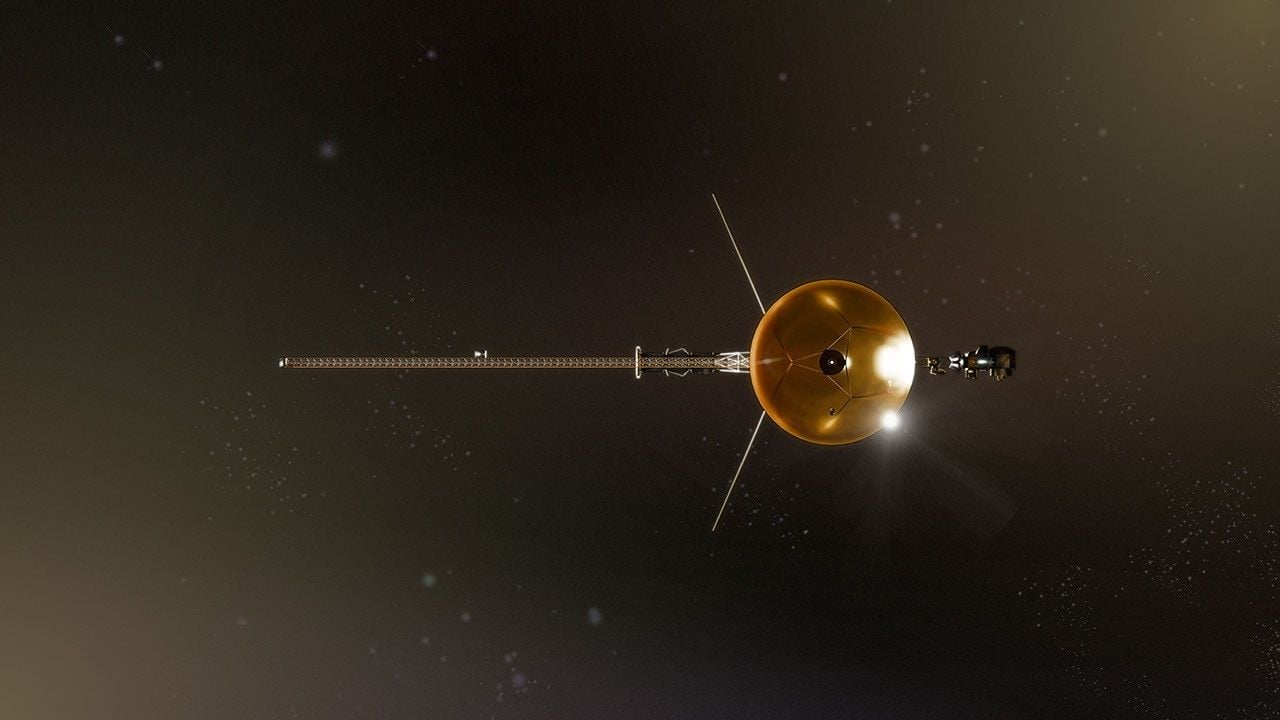
Garrett County’s dark skies are about to get a little brighter, and for an out-of-this-world reason. On Tuesday, Nov. 17, NASA is inviting people around the globe to point a light toward the sky after sunset to celebrate Voyager 1 becoming the first human-made object to travel one full light-day from Earth.
At 5:16 a.m. Eastern on Wednesday, Nov. 18, Voyager 1 will be about 16.1 billion miles from home, the distance light travels in 24 hours. That means a radio message from Earth takes a full day to reach the spacecraft, and a simple round-trip “hello” takes two. Voyager 1 launched on Sept. 5, 1977, flew past Jupiter and Saturn, and crossed into interstellar space in 2012. Its twin, Voyager 2, won’t reach the same mark until November 2035.
NASA is calling the celebration “Shine Bright for Voyager’s Light-Day.” Grab a flashlight, lantern, glow stick, bike light or your phone, head outside after sunset on Nov. 17 and flash “VGR,” Voyager’s call sign, in Morse code:
- V: three short flashes and one long flash (dot-dot-dot-dash)
- G: two long flashes and one short flash (dash-dash-dot)
- R: one short, one long and one short flash (dot-dash-dot)
Pause a second or more between letters, then repeat for about a minute. Rusty on your Morse code? NASA has a free web page that turns your phone or tablet into an automatic VGR flasher. You’ll find it, along with the full instructions, on NASA’s Shine Bright for Voyager’s Light-Day Page.
Want to aim your signal right at Voyager? The spacecraft is far too faint to see, but it’s traveling in the direction of the constellation Ophiuchus. From Deep Creek Lake, step outside between 6 and 7 p.m., face west and a little to the south, and aim two to three fists (held at arm’s length) above the horizon. Voyager’s patch of sky sinks lower as the evening goes on, so earlier is better, and a west-facing lakeshore or overlook gives you the clearest shot.
Whether you signal from your dock, a mountaintop overlook or your own backyard, snap a photo or video and share it on social media tagging @NASA. We’d love to see the Deep Creek Lake area’s part in NASA’s worldwide wave of golden light, so tag Deep Creek Times when you post, too.