



DEEP CREEK LAKE BOATING
Deep Creek Lake offers many wonderful recreational opportunities. With the ever-increasing number of boaters, everyone shares responsibility for working together to ensure our waters are clean and safe. Invest the time to educate yourself in the necessary safe practices by reviewing the following laws and safety tips.
IN CASE OF EMERGENCY
Maryland Natural Resources Police:
Channel 16 (156.8 MHz) or 800-628-9944
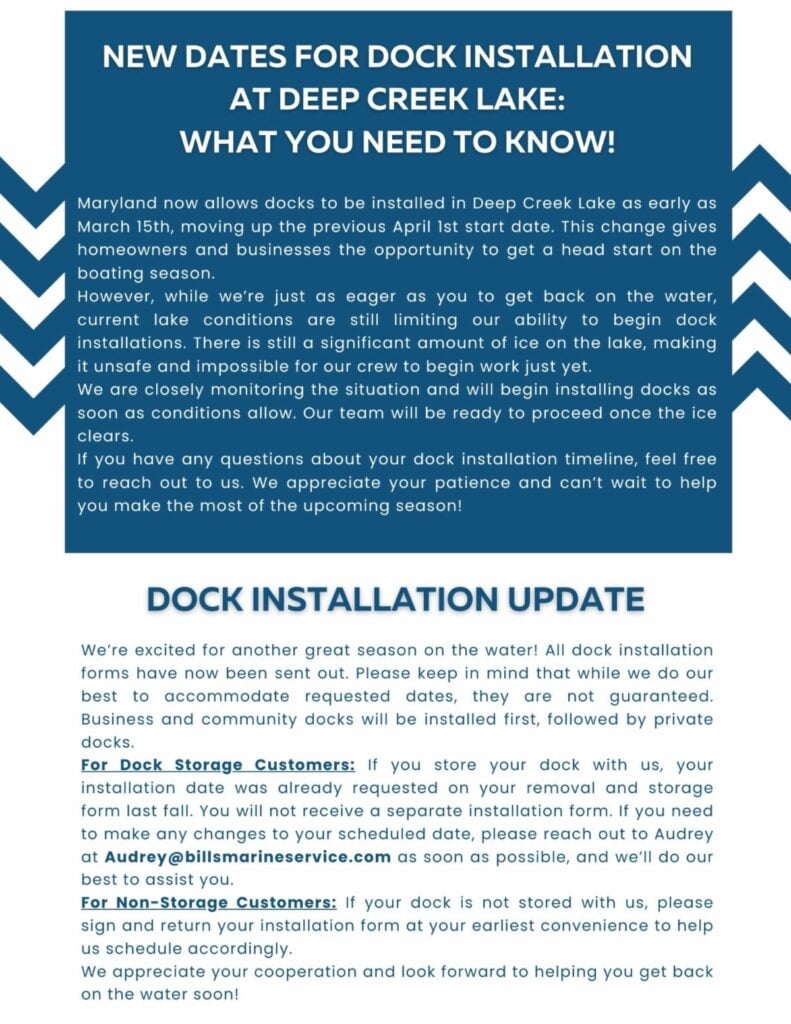
NEW DATES FOR DOCK INSTALLATION AT DEEP CREEK LAKE
REGULATIONS FOR INLAND WATERS
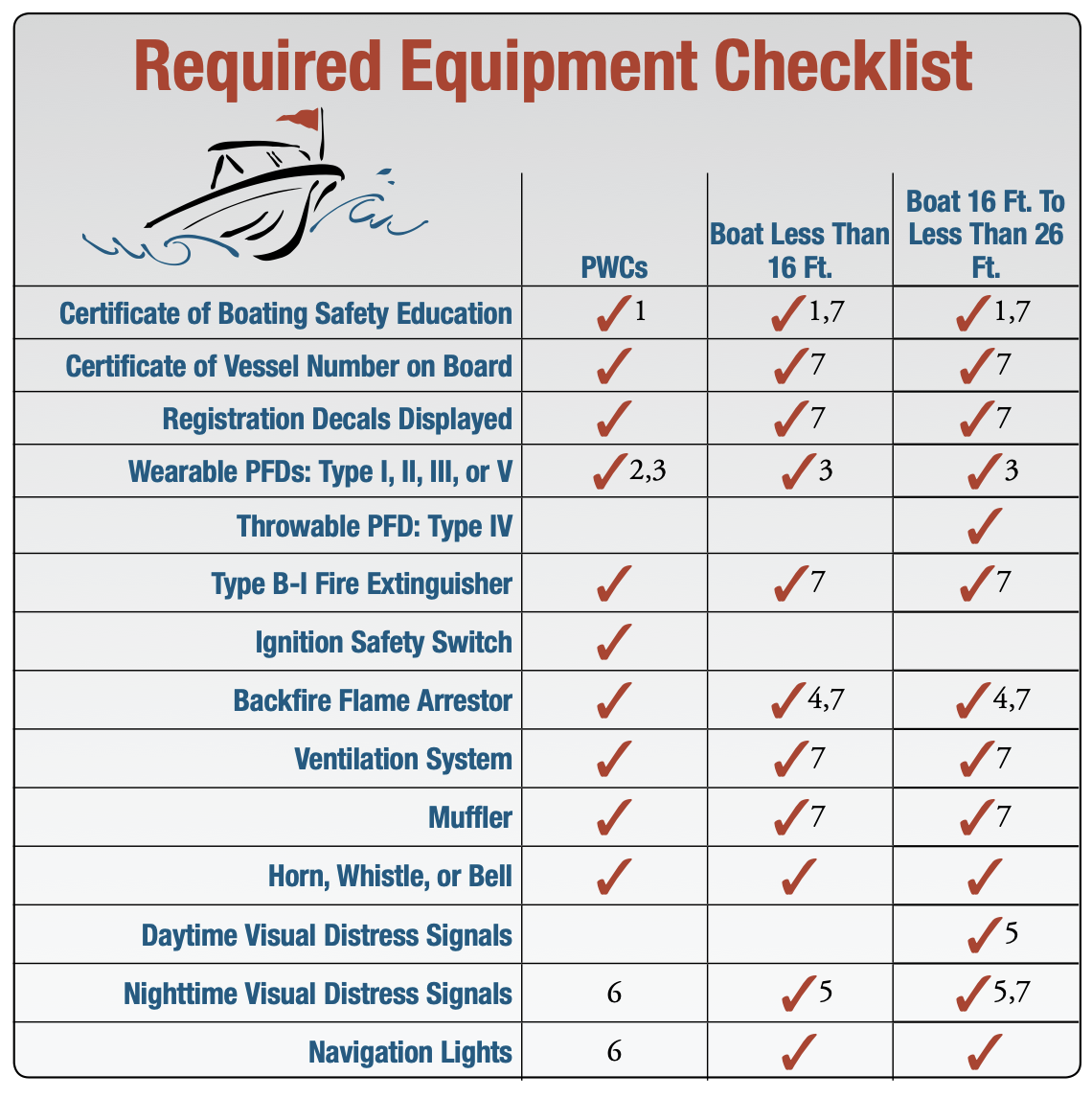
- Anyone born on or after July 1, 1972, operating a motorized vessel on Maryland waters must carry onboard an approved boating safety certificate.
- It is unlawful to operate a boat in a reckless or negligent manner or while under the influence of drugs or alcohol.
- A valid registration must be correctly displayed onboard.
- Navigation lights must be displayed from sunset to sunrise.
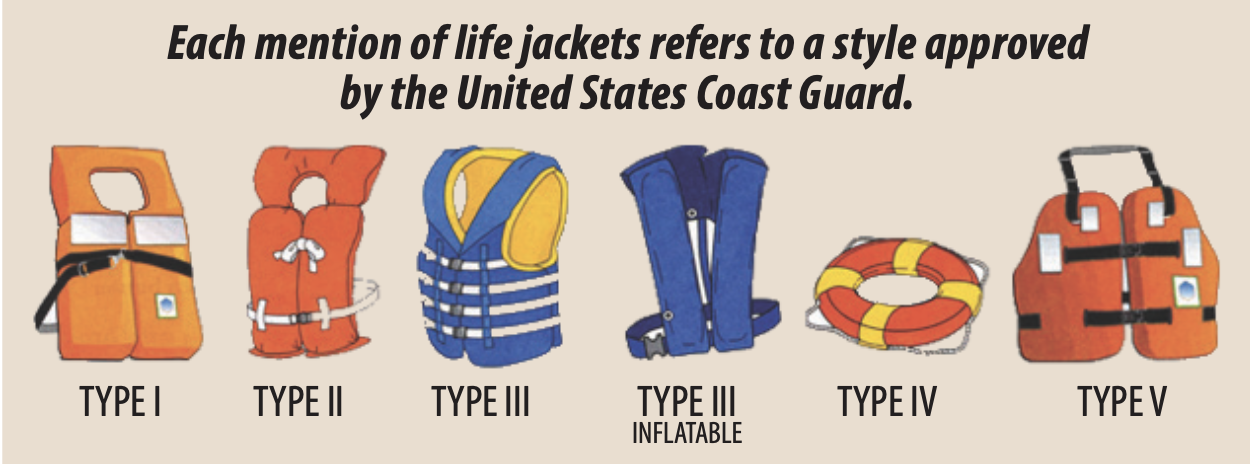
- A wearable life jacket must be carried for each person on board.
- Children under 13 must wear a life jacket when onboard a recreational vessel less than 21 feet long while underway. These include motorboats, sailboats, canoes, kayaks, rowboats, stand-up paddleboards, and any other mode of transportation on the water.
- Children under 4 years old must wear a life jacket that has additional safety precautions appropriate for an infant that will:
- Hold the child securely with a strap secured between the legs to fasten the front and back;
- Have a high collar to help maintain the buoyancy of the child; and
- Ensure a quick recovery of the child from the water by including a web handle.
- Personal watercraft may not be operated at speeds above six knots within 100 feet of any abutment, bridge, pier, shore, wharf, other personal watercraft, or people in the water.
- All Maryland-registered personal watercraft must display regulation stickers provided by the Natural Resources Police explaining the rules of operation.
- Operators of personal watercraft must be 16 years old or older.
- When wakeboarding, water skiing, or tubing, there must be an operator and an observer in the boat 12 years old or older.
- Wakeboarding, water skiing and tubing are not permitted within 100 feet of bridge pilings, docks, shore, boats, or other people.
- Water skiing is not allowed from sunset to sunrise.
Safe and fun water sports require boaters to use common sense and make good judgment calls. Don’t stay on the water too long. The effects of the sun, vibration, waves, and wind can
impair judgment.
Drinking alcoholic beverages, taking prescription drugs and over-the-counter medications, or using illegal drugs can contribute to impaired judgment. Never operate a vessel while intoxicated—it is dangerous and illegal.
Vessel operators are responsible for keeping towed people away from dangerous areas. If there is an obstruction, shut down the boat and wait for the area to clear. Before turning, look to each side and behind to make sure that there are no overtaking boats and that making a turn will not endanger the skier.
Remember, the person at the end of the towrope is an extension of the boat, and the operator must continually be aware of their presence and safety.
Boating Title and Registration Fees
Please be advised that an increase to boating title and registration fees was approved by the Maryland General Assembly in April 2025. The law adjusting the fees will become effective October 1, 2025. This represents the first adjustment to vessel title and registration fees in 42 years, addressing the rising costs of administering titles and registrations.
Boating Fee Increase FAQs
Why did the boating title and registration fees need to be increased?
Maryland’s boating title and registration fees were last increased in 1983. In the past 42 years, there have been significant increases to costs associated with providing support and administration of boating titles and registrations.
How were the fees determined?
The fees and structure were discussed with the Boat Act Advisory Committee’s leadership and representatives of industry groups. The most significant increase is the increase from $24 every two years to $70 every two years for boat registrations. This number was derived from using inflation to determine what the commensurate amount should be today compared to the 1983 level. The exact inflation-adjusted amount is higher (approximately $73), but the cost was rounded down to $70. There is also a voluntary $12 registration if individuals want to register their non-motorized vessels such as canoes and kayaks, so that the Natural Resource Police can easily identify owners if these vessels become loose during flooding or other events.
What additional services will be provided by the higher fees?
Because the fees had not increased in more than forty years, the agency had to use other funds to cover costs. Additional revenue will free up funds for projects that would provide additional and/or improved boating access in Maryland.
More information about safe boating is available on the Maryland Department of Natural Resources website.
THINGS YOU SHOULD KNOW ABOUT COLD WATER BOATING
-
Be prepared if you venture out on our waterways during the winter months. Cold-water immersion is the cause of many boating-related fatalities.
-
Check the weather forecast before boating.
-
Always wear a life jacket.
-
When at all possible, always boat with a buddy.
-
File a float plan.
-
Bring additional clothing and dress appropriately for the weather/water.
-
Even the most experienced boaters have unexpected accidents. Be prepared for anything.
More cold water boating tips can be found on the boating safety webpages.
REGULATIONS SPECIFIC TO DEEP CREEK LAKE
- Vessels may not exceed 26 feet in length, except pontoon boats, which may not exceed 30 feet.
- Vessels must be muffled so as not to exceed the state noise level limit of 88 decibels.
- Engines may not exceed the manufacturers’ recommended capacity or a displacement of 550 cubic inches—whichever is less.
- Houseboats are not permitted.
- Parasailing is not permitted.
- No garbage, sewage or other waste materials may be discharged into the water.
- Aircraft are prohibited on both the lake and buffer strip unless prior approval has been obtained from the Department of Natural Resources.
- Hovercraft and personal watercraft (Jet Skis, Sea Doos, etc.) may not be operated on the lake between 11:00 AM and 4:00 PM on Saturday – Monday of Memorial Day Weekend, and Saturdays, Sundays and holidays from July 1 through Labor Day.

SAFETY TIPS
- Know and obey the rules.
- Display required dock number plate and use the nearest number to identify your location in an emergency event.
- Be attentive and look out for others.
- Control your speed and dock slowly—boats have no brakes.
- Navigate carefully into narrow coves and watch for restrictions.
- Watch your wake. You’re responsible for damage it may cause.
- Never swim near a running engine.
- Always sit in a moving boat—never on it.
- Be respectful of Natural Resources Police officers, who are there for your safety.
- Control personal watercraft speed safely—jet drives have no steering when you cut power. Keep required distances from other boats, docks and the shore.
- When overtaking another boat from behind, the boat in front has the right of way.
- When tubing, the operator, not the rider, has control:
- Be aware of the length of towrope.
- Avoid the shore, other boats and docks.
- Don’t roughhouse.
- Make sure you have enough room for turns.
- When wakeboarding/wake surfing, watch your wake and avoid damage to other boats, docks and shoreline. Empty the ballast tank when not towing someone.
- When waterskiing, have a good observer, obey distance rules and use hand signals.
- Powerboats must yield right of way to canoes, kayaks, paddleboards, sailboats, sailboards and rowboats.
- Smaller craft should ensure they are visible to larger craft.
LAWS FOR TOWING VESSEL OPERATORS
- Anyone being towed behind a vessel on water skis or any other device must wear a type I, II or III life jacket.
- No one under 12 years old may operate a vessel towing a person(s) on water skis, or any other device.
- Every vessel towing a person(s) must have onboard both an operator and an observer 12 years old or older.
- A vessel may tow a person(s) only from sunrise to sunset.
- It is illegal to operate any vessel, or manipulate any water skis or any similar device, in a careless, reckless or negligent manner that endangers the life, limb or property of anyone.
- Except for taking off from shore, the towing vessel must stay at least 100 feet from bridges, piers, people in the water and other vessels, and the shore.
- A personal watercraft may not be used to tow unless it has the capacity to carry at least three people: the operator, a rear-facing observer 12 years old or older, and the skier.
- Ski ropes may not be more than 75 feet long, except when barefoot skiing, in which case a ski rope 100 feet long may be used.
CHANGES TO BOATING REGULATIONS
The Maryland Department of Natural Resources is sharing proposed boating regulation ideas to gather public feedback and help shape future updates. Requests for boating regulation changes are accepted each year through April 15, with late submissions reviewed the following year. For questions or more information, contact Mike Lathroum at 410-260-8272 or kennethm.lathroum@maryland.gov.