
The first solar eclipse of 2026 will be an annular – sometimes called a “ring of fire” – solar eclipse on Tuesday, February 17. This annular solar eclipse will be fun to think about. But only a few hundred million of Earth’s 8.3 billion inhabitants will see even the partial phases. The partial eclipse will be visible from areas including the southern tip of South America, southern Africa, the Pacific, Atlantic and Indian Oceans, and most of Antarctica. Meanwhile, the path of the annular eclipse will cross remote parts of Antarctica and the southern regions of the Southern Ocean.
It’ll be viewed mainly from year-round scientific research stations in Antarctica, including the Concordia Research Station (a French-Italian station) and the Russian Mirny Station in Queen Mary Land on the eastern part of the continent. The primary American base in Antarctica is McMurdo Station. McMurdo will see a deep partial eclipse, with the sun 86% blotted out by the moon.
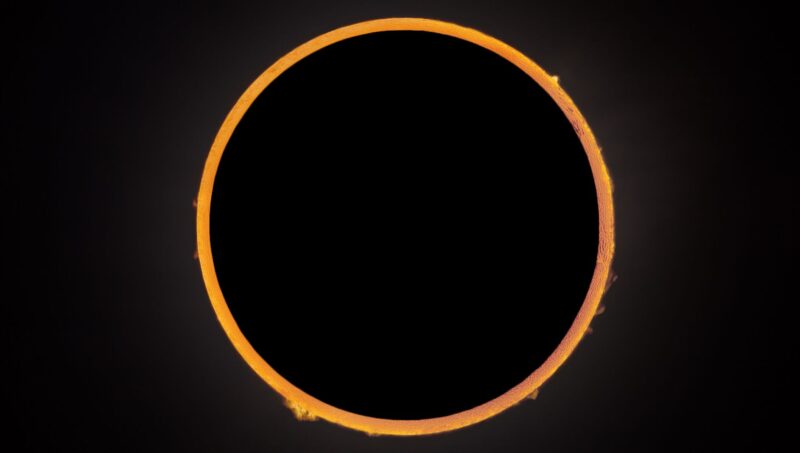
View at EarthSky Community Photos. | Alan Howell from Albuquerque, New Mexico, captured this photo during the annular solar eclipse of October 14, 2023. He wrote: “What an incredible adventure! It took months of planning, gear testing, software and equipment training, booking flights and hotels, car traveling, weather forecast monitoring, and location scouting to produce this colorized H-alpha image of the ‘ring of fire’ eclipse, showing prominences.” Thank you, Alan!
Eclipse Times
Here are some times for the annular solar eclipse on February 17, 2026:
- Partial eclipse begins at 9:56 UTC
- Maximum eclipse begins at 12:12 UTC
- Partial eclipse ends at 14:27 UTC
NOTE: An annular eclipse is a partial eclipse. You must use the proper eye protection at all times. This eclipse is never safe to view without it.
Why is it Called an Annular Eclipse?
Astronomers call this an annular eclipse of the sun. That name comes from the Latin word for ring: annulus. During this eclipse, the moon will be too far away in its orbit to cover the sun completely. At mid-eclipse, the outer surface of the sun will appear in a ring around the moon.
So, though not as dramatic as a total solar eclipse, an annular eclipse is fascinating to view. The sky darkens as the partial phases deepen. Little crescent suns appear all around you, as the tiny gaps between tree leaves act like camera lenses, projecting an inverted image of the sun onto the ground below or nearby walls. But, during an annular eclipse, the sky never turns completely dark. Stars and planets don’t pop into view. It’s the sun itself – and the tiny projected crescents – that’ll captivate you.
As for any eclipse, you really only need to know two things. First, how much of the sun will be covered from your location? Second, what time is the eclipse from your location? But again, for the February 17, 2026, eclipse, only those at the southernmost part of Earth will see even the partial phases.
Overall, the February 17, 2026, annular eclipse will last 271 minutes. At maximum eclipse – for those using safe solar viewing techniques along the central eclipse path – the sun will be 96% covered by the moon. The sun will show the “ring of fire” effect for about 2 minutes and 20 seconds.
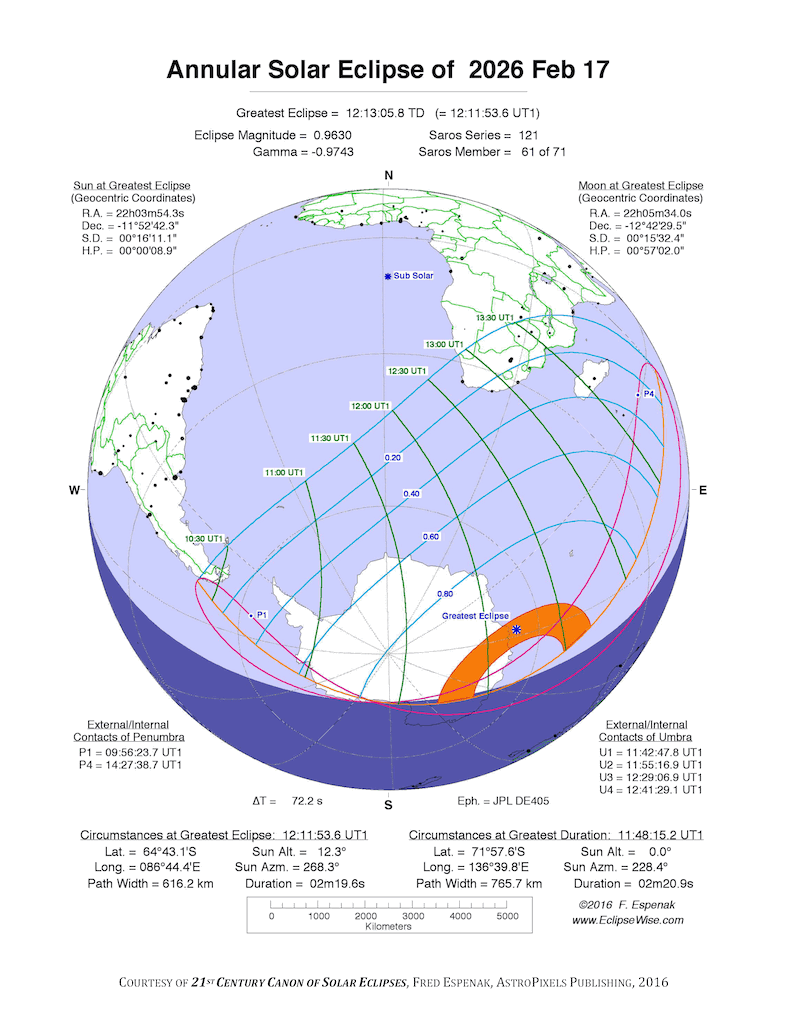
The orange line shows the path of the February 17, 2026, annular solar eclipse. And those farther from the path will see a partial solar eclipse. Image via Fred Espenak. Used with permission.
Overview of the February 17 Annular Solar Eclipse
The February 17 annular eclipse will begin at 11:42 UTC. That’s when the moon’s antumbral shadow first falls on Earth, sweeping along a path on Earth’s surface that is 383 miles (616 km) wide and 2,661 miles (4,282 km) long.
Then the annular eclipse sun will reach its greatest eclipse at 12:13 UTC with a duration of 2 minutes and 20 seconds.
Note that, for us in the Americas, this eclipse will be taking place overnight on February 16-17. The greatest eclipse will fall at 12:13 UTC, 13 minutes after midnight, Central Standard Time, on February 17.
Meanwhile, those outside the shadow path will see a partial solar eclipse. Important: this is not a total eclipse. And the first thing to remember, at no time during this eclipse will it be safe to look at the sun without proper eye protection.
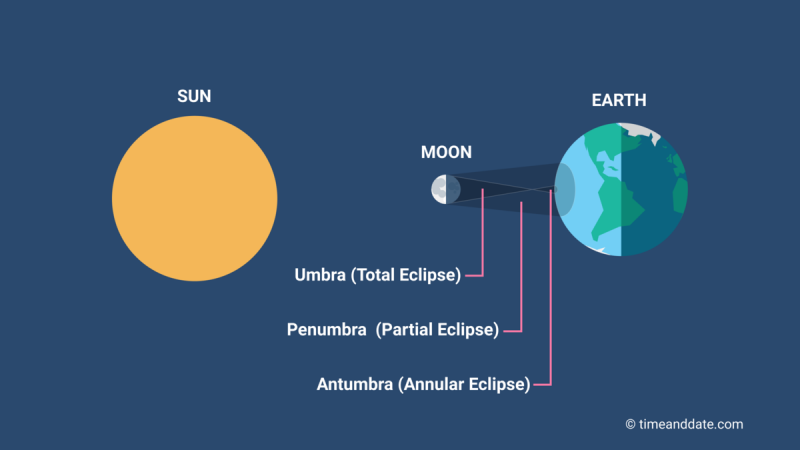
The moon’s dark umbra and antumbra – an extension of the umbral shadow, made relevant now because of the moon’s distance from Earth – surrounded by the lighter part of the shadow, called the penumbra. Image via timeanddate.com. Used with permission.
Moon, Constellation, Saros
The greatest eclipse takes place at 12:11 UTC on February 17, 6.8 days after the moon reaches apogee, its farthest point from Earth for the month. During the February 17, 2026, eclipse, the sun is located in the direction of the constellation Aquarius.
This eclipse has a magnitude of 0.9630.
The Saros catalog describes the periodicity of eclipses. The eclipse belongs to Saros 121. It is number 61 of 71 eclipses in the series. All eclipses in this series occur at the moon’s ascending node. The moon moves southward with respect to the node with each succeeding eclipse in the series.
This is 2026’s 1st Solar Eclipse
There will be a second solar eclipse in 2026 – on August 12, 2026 – and it’ll be a total solar eclipse whose path of totality passes over the Arctic, Greenland, Iceland, and Spain. And observers in much of Western Europe and North America will see a partial eclipse.
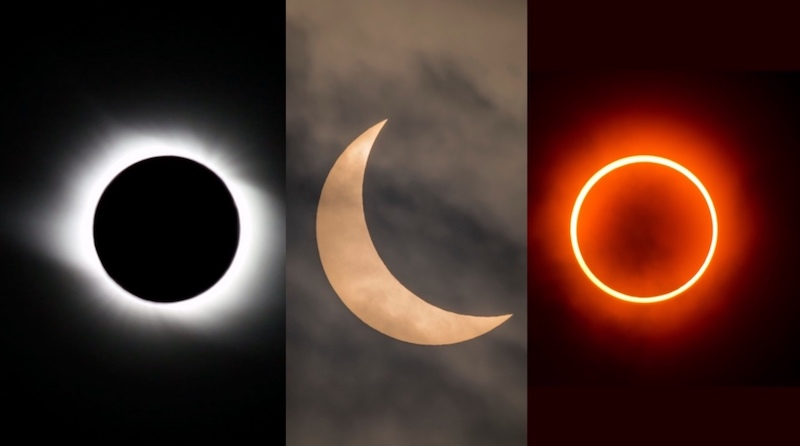
The appearance of a total solar eclipse (left), partial solar eclipse (middle) and annular solar eclipse (right). The one on the right – the annular eclipse – is what those along the eclipse path will see on February 17, 2026. Image via K. Bikos/ timeanddate.com. Used with permission.
Bottom line: On February 17, 2026, an annular solar eclipse will be visible from Antarctica and the Southern Ocean. Also, it’ll be visible as a partial eclipse from areas including the southern tip of South America, southern Africa, and most of Antarctica.
Originally published by EarthSky.