Ever wonder how Garrett County towns were named? No? Why not? Work with me here.
Most town names seem pretty straightforward, while others might leave you scratching your head. All that mattered was that the name made sense at the time. The fact that these names are still in use suggests an acknowledgement of the perseverance of early settlers. Or, it’s evidence that newcomers were too busy to name it for anything but themselves. In all fairness, they deserved it.
As was the case for many places in Maryland’s Appalachian counties, these town names recognized early landowners, railroad figures, or pioneer families. It was a common naming process. Often, all inhabitants were related to those who first settled their respective area. To have a place named for a family was a tribute to their pioneering spirit. Either that or it reflected that something unexpected happened there. More on that later.
The naming process might have been a little more difficult than it would seem at first blush. Imagine a group of settlers gathered around a campfire in 1800. They’ve cleared a couple of trees, built a few cabins, and are feeling optimistic enough to call their collection of stumps a town.
“We need a name,” says one.
“What about Pleasant Valley?” suggests another.
“No,” says another, “it’s already taken.”
“How about Cedar Grove or Pine Ridge or Oak Plains?”
“Taken, taken, and taken.”
“This is more difficult than I figured it would be. Can’t we just call it ‘Wide
Spot in the Road by the Bear’s Den’? “
“Works for me,” said one and they all agreed, knowing the uniqueness of the name would not be copied by anyone else. And all was well until the bear decided to return and reclaim its territory, thereby necessitating a change in venue as well as another naming session. C’est la vie.
As large as Garrett County is (655 square miles and the largest county in Maryland), there are only eight incorporated municipalities, each with their own town government. These are: Accident, Deer Park, Friendsville, Grantsville, Kitzmiller, Loch Lynn Heights, Mountain Lake Park, and Oakland.
In addition, there are well over 100 named districts (towns, villages, crossroads, hamlets, and populated places). These unincorporated areas are part of Garrett County and are managed by the county rather than a local government.
Hmm, what’s the difference?
Unlike residents of incorporated towns, people in unincorporated areas do not have a mayor or town council. Instead, they are represented directly by the elected Garrett County Board of Commissioners, which serves as the county’s governing body. As a result, the county government acts as the principal provider of local services for most residents, while the incorporated towns maintain authority over their own municipal affairs. With a relatively small population spread across Maryland’s largest county, county-level administration is generally more practical than creating dozens of small municipal governments. Well, that makes sense.
Many unincorporated communities retain strong local identities despite lacking municipal governments. Places such as McHenry, Finzel, and Swanton have post offices, churches, volunteer fire departments, schools, businesses, and community organization that function as local centers. Residents often identify strongly with these communities even though they are not legally incorporated. But fear not. It’s not as if someone may be going to jail because I suspect the statutes of limitation are up.
Let’s begin with the naming of Garrett County. Francesca Branson’s wonderfully detailed piece, The Railroad’s Essential Role, in the May issue of The Lakefront Magazine, describes John Work Garrett’s important contributions to the opening of this area to tourism and economic development. His influence was a result of his impact on the development of the Baltimore & Ohio (B&O) railroad.
Before the B&O reached here in the early 1850s, travel through the Allegheny Mountains was difficult and slow. The railroad linked our region with Baltimore, Washington, Pittsburgh, and the Midwest. This connection made it possible to efficiently transport coal, timber, agricultural products, and passengers. There was no mention of bootlegging, but who knows. Oakland itself was laid out in 1849 after the B&O selected the route through the area, and the town quickly became an important rail center.
Thanks to our natural environment, John Work Garrett was able to promote our area as a desirable mountain resort region. This brought wealthy travelers to the Deer Park Hotel and other resorts. Presidents Ulysses S. Grant, Benjamin Harrison, Grover Cleveland, and William McKinley joined other industrialists, politicians, and celebrties who rode B&O passenger trains into the mountains to stay at the Deer Park Hotel and other resorts.
Smaller towns probably followed the tradition of naming towns after landowners or early pioneers. Examples include Bittinger, Crellin, Finzel, Floyd, Friendsville, Gorman, Gortner, Herrington Manor, Hutton, Hoyes, Jennings, Kearney, Kempton, Kendall, Kitzmiller, McHenry, Merrill, Mitchell Manor, Schell, Shallmar, Steyer, Strawn, Strecker, Swanton, Thayerville, Wallman, and Wilson.
Other towns were named for landscape features, mills, railroad stops, or rivers. A few have documented origins, while others survive mostly through local tradition and historical usage. Examples include: Altamont (from Spanish/Latin roots meaning “high mountain”); Bowling Green (indicating a flat common or recreational area); Camp Whitethorn (for whitethorn or hawthorn shrubs); Elder Hill (probably named for elderberry trees); Fairview (for scenic mountain views); and Foxtown (probably named for fox hunting or plentiful foxes).
Many others were fairly self-explanatory, such as Gravel Hill, High Point, Locust Grove, North Glade, Piney Grove, Redhouse, Sand Spring, Sang Run (short for ginseng), Mineral Spring, Table Rock, and Winding Ridge.
Others have unusual names. For example, Accident. Local legend has it that the town received its curious name in the 1700s when two surveyors accidentally selected the same parcel of land independently while laying out land grants. The overlap was referred to as an “accident,” and the name stuck. I suppose the town might also have just as easily been named “Oops.”
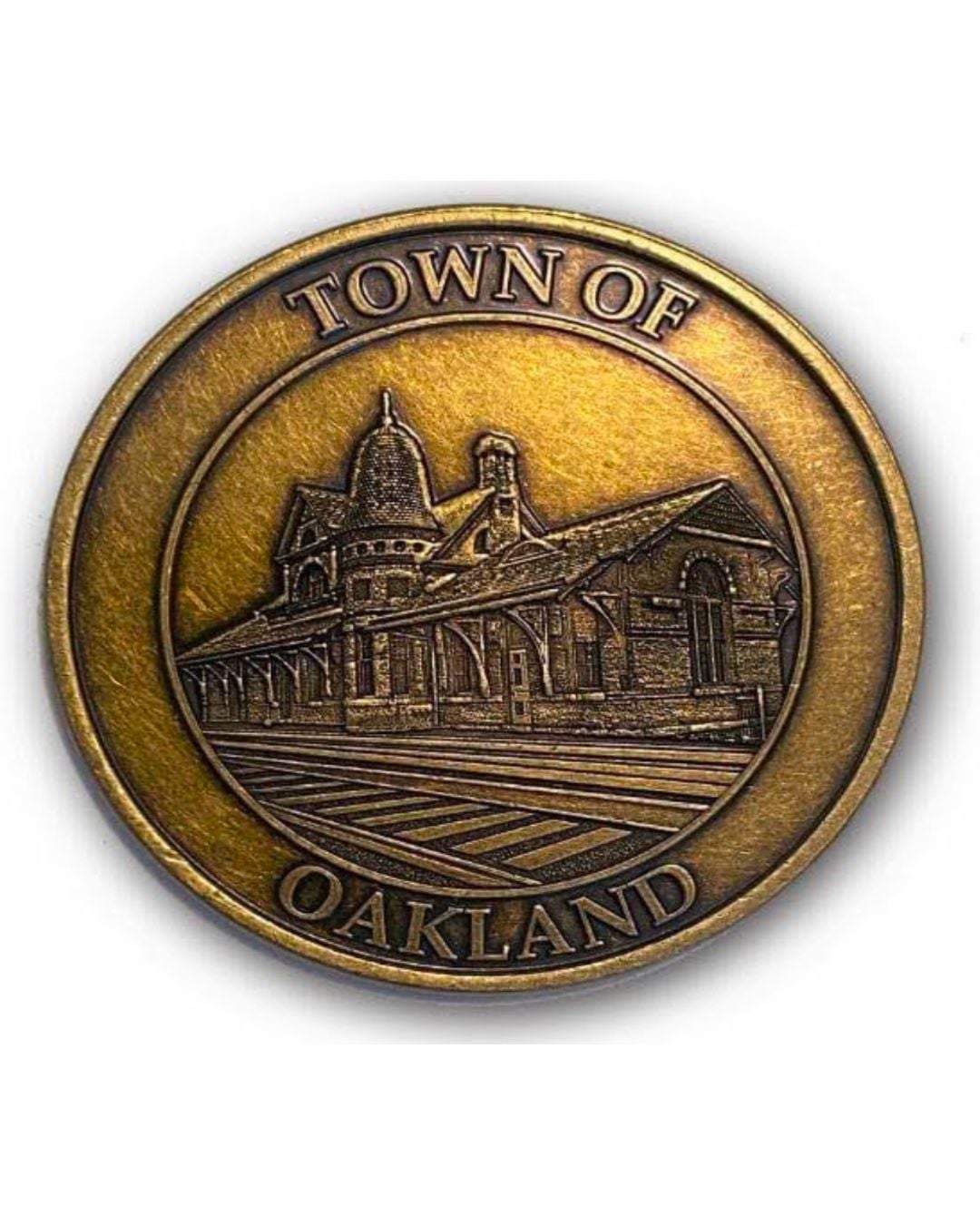
Other towns were named for more “obvious” reasons. Oakland was named for the abundant oak trees surrounding the original settlement. Deer Park was named because the area was once known for large numbers of deer roaming the mountain forests and meadows. Grantsville was named for General Ulysses S. Grant. However, during the Civil War era, the town’s earlier name was Jenningsville and later was changed to honor Grant. Others have similar name sources: Green Glade for a lush green glade near Deep Creek Lake; Hazelhurst for hazel trees; Loch Lynn, a resort name meaning lake waterfall or lake pool; Sand Spring for groundwater sources; and Table Rock, for a flat rock atop Backbone Mountain.
So, there you have it. If you want to try your hand at naming a town, just buy up some unincorporated acreage, add a few fenceposts and some signage. Maybe you’ll consider calling your new town “Oops.”
Written by Tony Lolli.
From the July issue of the Lakefront Magazine.