
March 28 and 29 Evenings: Moon, Regulus, and the Sickle

On the evenings of March 28 and 29, the waxing gibbous moon will be near Regulus, the brightest star in Leothe Lion. Regulus is the bright dot at the bottom of a backward question-mark pattern of stars known as the Sickle. They’ll set before sunrise the next morning. Chart via EarthSky.
April 1-2 All Night: Full Pink Moon near Spica

On the evening of April 1, the full Pink Moon will lie below the bright star Spica. If you can’t spot Spica in the bright moon glow, block out the moon with a finger, and the star will pop into view. The crest of the full moon will be at 2:12 UTC on April 2. That’ll be 9:12 CDT on April 1. The moon will look full and round all night. Chart via EarthSky.
April 2 Evening: Moon near Spica

On the evening of April 2, the waning gibbous moon will be near Spica, the brightest star in Virgo the Maiden. You can also catch them through dawn. Chart via EarthSky.
Southern Hemisphere: Mercury Farthest from Sunrise on April 3

On April 3, 2026, Mercury will reach what astronomers called greatest elongation. That’s when Mercury is farthest (28 degrees) from the sunrise. This is the Southern Hemisphere view, and it’s a great time to spot Mercury and Mars from the Southern Hemisphere! From the Northern Hemisphere, the ecliptic – or sun’s path (green line on our chart) – will slant down to the right. So Mars and Mercury will appear closer to the horizon and will be much harder to see. After April 3, Mercury will drop back toward the sunrise. It’ll be getting brighter, making it briefly easier to spot in the morning twilight, before it disappears in the sun’s glare. Meanwhile, Mars will continue its steady climb away from the sunrise, in the weeks and months to come. Chart via EarthSky.
April 3 Evening: Moon near Spica and Zubenelgenubi

In the evening hours of April 3, the waning gibbous moon will float near the moderately bright star with the odd-sounding name, Zubenelgenubi. It’s the brightest star in the Libra the Scales. The bright star Spica is nearby. You can catch them through dawn the next morning. Chart via EarthSky.
April Evening Planets

Sphere chart showing bright Jupiter and Venus about 60 minutes after sunset in the April evening sky. Each day, Venus will ascend higher while Jupiter moves closer to the western horizon. They will have a spectacular close encounter in June. Note that these planets lie along the path the sun travels in the daytime (the green line on our chart). Chart via EarthSky.
April 6 and 7 Mornings: Moon Meets up with Antares and Scorpius

On the morning of April 6, the waning gibbous moon will be near the bright red star Antares. Also nearby are 3 moderately bright stars known collectively as the Crown of Scorpius. Then on the morning of April 7, the moon will be near the distinctive letter J – or fishhook – pattern of stars that makes up the constellation of Scorpiusthe Scorpion. Look for them before dawn. Chart via EarthSky.
April 7: Moon Reaches Apogee
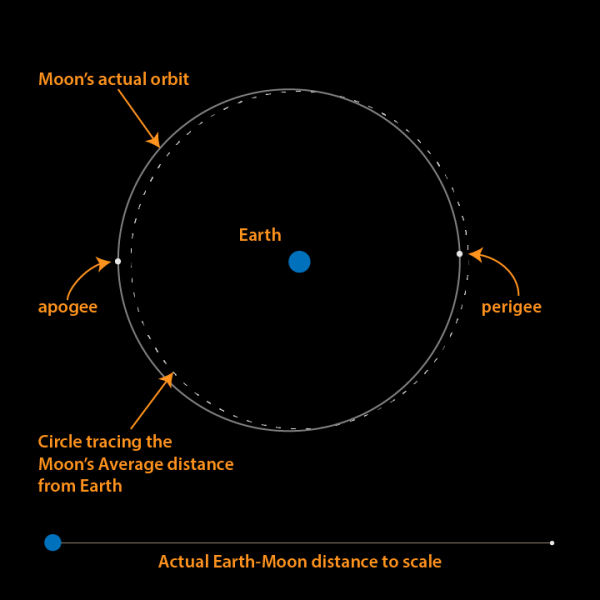
The moon’s orbit around Earth isn’t a circle. But it’s nearly circular, as the above diagram shows. The moon will reach apogee – its farthest distance from Earth in its elliptical orbit – at 9 UTC on April 7, 2026, when it’s 251,636 miles (404,970 km) away. Diagram by Brian Koberlein. Used with permission.
April 8 and 9 Mornings: Moon and the Teapot

On the mornings of April 8 and 9, the waning gibbous moon will hang close to the asterism of Sagittarius called the Teapot. Look for them about a few hours before dawn. Chart via EarthSky.
April 10: Watch for the 3rd Quarter Moon

View at EarthSky Community Photos. | Mohamed Mohamed in Tripoli, Libya, captured the last quarter moon on December 23, 2024. Thank you, Mohamed! The moment of the 3rd quarter moon will fall at 4:52 UTC on April 10, 2026. That’s 11:52 p.m. CDT on April 9. It’ll rise after midnight your local time and set around noon. Look for it high in the sky before dawn.
April 11 and 12 Mornings: Moon near Capricornus

On the mornings of April 11 and 12, the waning crescent moon will shine in front of the stars of the constellations of Capricornus the Sea Goat. The stars of Capricornus form a pattern that resembles an arrowhead. Look for them about 60 minutes before sunrise. However, the constellation is faint. Therefore, you’ll need a dark sky to spot it. Chart via EarthSky.
April 13 and 14 Mornings: Slender Old Crescent Moon

A thin waning crescent moon will hang low near the eastern horizon on April 13 and 14. Look for the delicate glow of earthshine on the unlit portion of the moon. That’s light reflected off the Earth. Look for them about an hour before sunrise. Chart via EarthSky.
April 15 Morning, Southern Hemisphere: Moon near Mercury, Mars, and Saturn

On April 15, from the Southern Hemisphere, a thin waning crescent moon will shine above Mercury, Mars and Saturn. Look for them about 60 minutes before sunrise. Mercury will rise first in the eastern morning twilight. Below it in the bright twilight are the fainter planets Mars and Saturn. Meanwhile, observers in the Northern Hemisphere will probably only see the waning crescent moon. Chart via EarthSky.
The mid-April Daytime Planet Parade

Planet parades are popular on social media. They aren’t that unusual, though, because the planets always follow a line across the sky. Here’s a sphere chart showing the daylight view – around noon on April 15 – of the sun and all 5 bright planets in our solar system. Of course, you won’t be able to see the planets during the day. Even though we can’t see them, they are there along the ecliptic (the green line). The ecliptic is the path the sun takes across our sky. You’ll find the moon and planets follow that path as well. So in April, Mercury, Mars and Saturn are rising and setting before the sun. And Venus and Jupiter are following the sun, so you can still spot them for a while after the sun sets. Chart via EarthSky.
April 17: New Supermoon

This GOES-19 CORR1 coronagraph from November 18-19, 2025 (designed to show coronal mass ejections from the sun), captured a fun view of the new moon, which would normally not be visible from Earth during this phase. The moment of new moon will fall at 11:52 UTC on April 17, 2026. That’s 6:52 a.m. CDT on April 17. In fact, this is the first of 5 new supermoons in a row. It’ll be 226,299 miles (364,194 kilometers) away. Compare that with the average moon distance of 238,900 miles (384,472 km). New moons rise and set with the sun. Nights around the new moon are perfect for stargazing. See EarthSky’s best places to stargaze. Images via NOAA/GOES.
April Morning Planets: Northern Hemisphere

All-sky chart showing 3 planets low in the east shortly before sunrise from mid-to-late April. The brightest will be Mercury. Saturn and Mars are much dimmer than Mercury. Mercury will descend and slip away by early next month. Meanwhile, Mars and Saturn will continue to ascend and be visible before dawn later this spring. Note that these planets lie along the path the sun travels in the daytime (the green line on our chart). Chart via EarthSky.
April 18 and 19 After Sunset: Moon, Venus, Aldebaran, and the Pleiades

On the evenings of April 18 and 19, check out the pretty waxing crescent moon. It’ll hang low in the western sky after sunset. And it’ll be near the brilliant planet Venus. Look for them about an hour after sunset. On April 18, it’ll make a close pass by brilliant Venus. Then on the next evening, it’ll lie near the famous Pleiades star cluster, also known as the 7 Sisters. The bright orange giant star Aldebaran is nearby. The Pleiades star cluster and Aldebaran are in the constellation Taurus the Bull. They’ll set before midnight. Chart via EarthSky.
April 19: Moon Reaches Perigee
The moon’s orbit around Earth isn’t a circle. But it’s nearly circular, as the above diagram shows. The moon will reach perigee – its closest point to us in its elliptical orbit around Earth – at 7 UTC on April 19, 2026. Then it’ll be 224,706 miles (361,630 km) away from Earth. Diagram by Brian Koberlein. Used with permission.
April 20 Morning, Southern Hemisphere: Tight Trio of Planets in the Morning Twilight

On the morning of April 20, viewers in the Southern Hemisphere will see 3 planets – Mercury, Saturn and Mars – bunched together low on the eastern horizon. Look for them around dawn or at the beginning of morning twilight. Mercury will easily be the brightest and easiest to spot of the 3 planets. Observers in the northern latitudes may not be able to spot the planets that morning. Chart via EarthSky.
April 20 Evening: Moon, Venus, and the Pleiades

On April 20, about 90 minutes after sunset, the waxing crescent moon will hang near Venus. The bright star Aldebaran and the delicate Pleiades star cluster will lie between them. They’ll set around midnight. Chart via EarthSky.
April 21 and 22 Evenings: Moon, Jupiter, and Twin Stars

On the evenings of April 22 and 23, the waxing crescent moon will lie near bright Jupiter and the twin stars of Gemini, Castor and Pollux. They’ll set after midnight. Chart via EarthSky.
April 22: Lyrid Meteor Shower
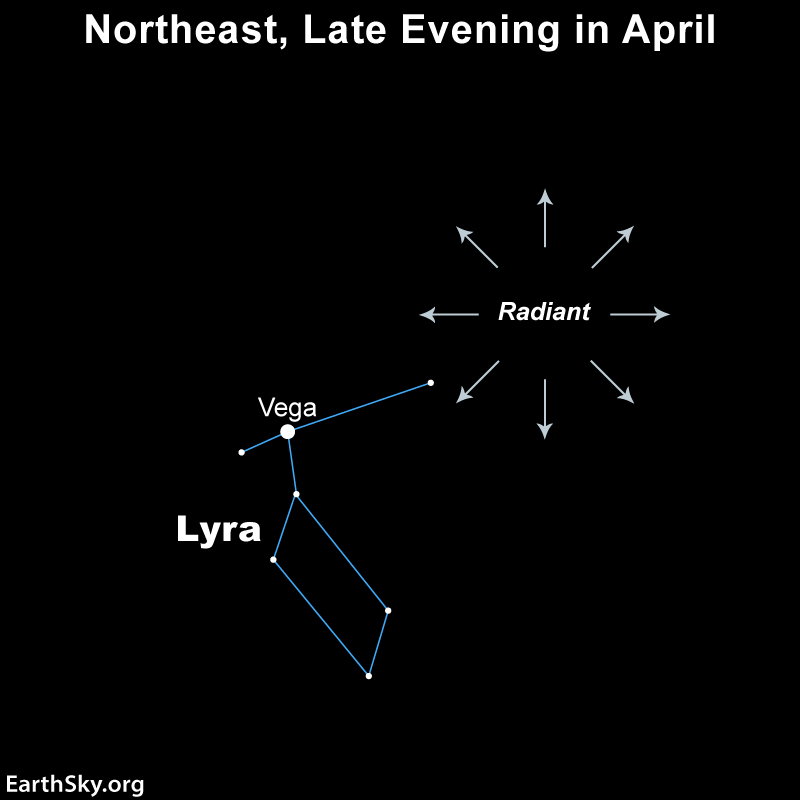
Lyrid meteors radiate from near the bright star Vega in the constellation Lyra the Harp. You don’t need to identify Vega or Lyra in order to watch the Lyrid meteor shower. But you do need to know when the radiantrises. It’ll rise in the northeast before midnight. The best time to watch is after midnight and before dawn – in a moon-free sky – on the morning of April 22.
April 24: 1st Quarter Moon
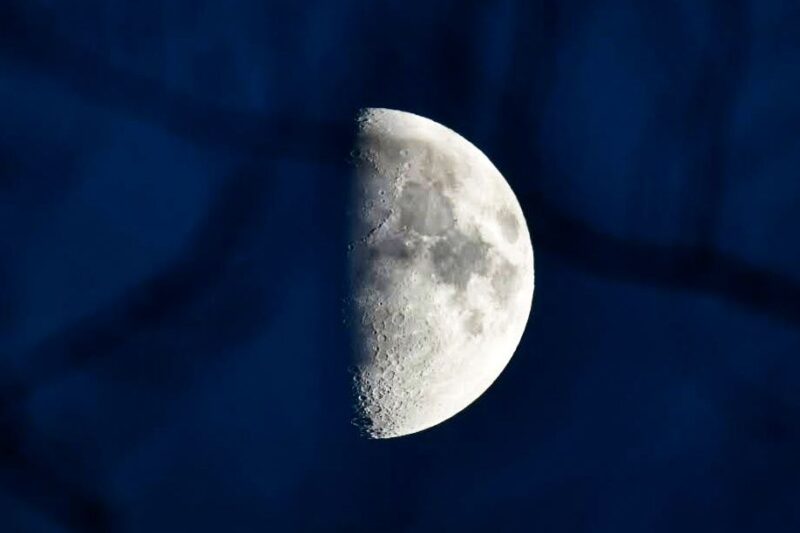
View at EarthSky Community Photos. | Lorraine Boyd captured this view from New York on November 9, 2024. She wrote: “Peeking through tree limbs at the first quarter moon (50% illumination), just after sunset.” Thank you, Lorraine. This month’s moment of 1st quarter moon will fall at 2:32 UTC on April 24, 2026. That’s 9:32 p.m. CDT on April 23. A 1st quarter moon rises around noon your local time and sets around midnight. Watch for a 1st quarter moon high in the sky at sundown.
April 24 and 25 Evenings: Moon, Regulus, and the Sickle

On the evenings of April 24 and 25, the waxing gibbous moon will be near Regulus, the brightest star in Leo the Lion. Regulus is the bright dot at the bottom of a backward question-mark pattern of stars known as the Sickle. They’ll set several hours after midnight. Chart via EarthSky.
April 28, 29, and 30 Evenings: Moon and Spica

Late on the evenings of April 28, 29 and 30, the waxing gibbous moon will be near Spica, the brightest star in Virgo the Maiden. The star might be hard to see in the moon’s bright glow. You can also catch them before dawn. Chart via EarthSky.
April Stars and Constellations
If you’re out stargazing on any April evening, look for these stars and constellations high overhead in the evening sky. Give your eyes time to adjust to the darkness.
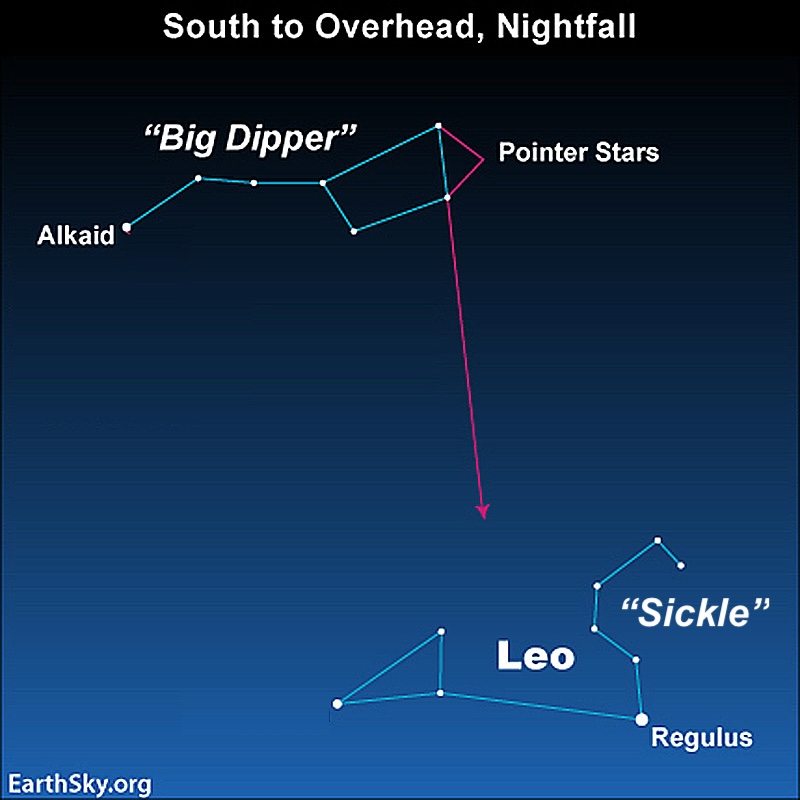
You can use the Big Dipper to locate Leo the Lion. Draw an imaginary line southward from the pointer stars in the Big Dipper – the 2 outer stars in the Dipper’s bowl – to point toward Leo the Lion. The brightest star in Leo is Regulus. Under darker skies, you’ll see Regulus marks the bright dot at the bottom of the backward question mark that forms Leo’s Sickle. It’s also an asterism and part of Leo the Lion.

The Spring Triangle is an asterism with 3 bright stars at its corners: Arcturus, Spica, and Regulus. All 3 stars are in different constellations. And some stargazers speak of the Spring Triangle as including Denebola instead of Regulus. Image via EarthSky.
April Evening Planets
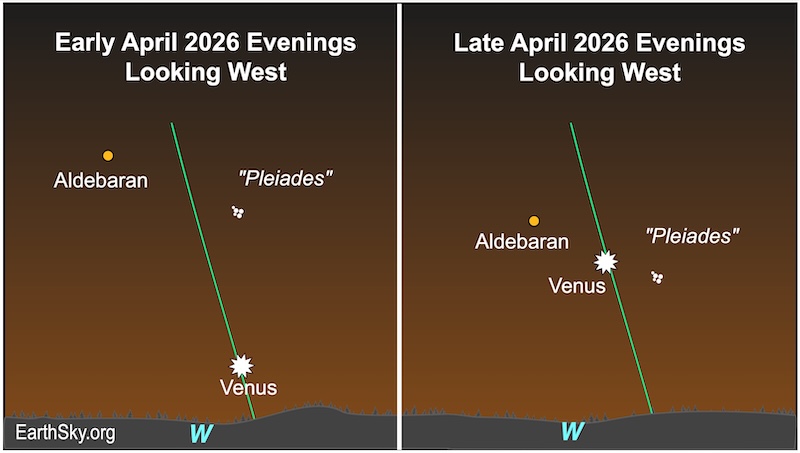
In the first half of April, brilliant Venus will be low in the west, near the Pleiades star cluster and the orange star Aldebaran. By month’s end, Venus has climbed higher, moving between the Pleiades and Aldebaran. It’ll set about 90 minutes after sunset on April 1. And it’ll set about 2 hours after sunset on April 30. The waxing crescent moon will be near Venus on April 19. Chart via EarthSky.
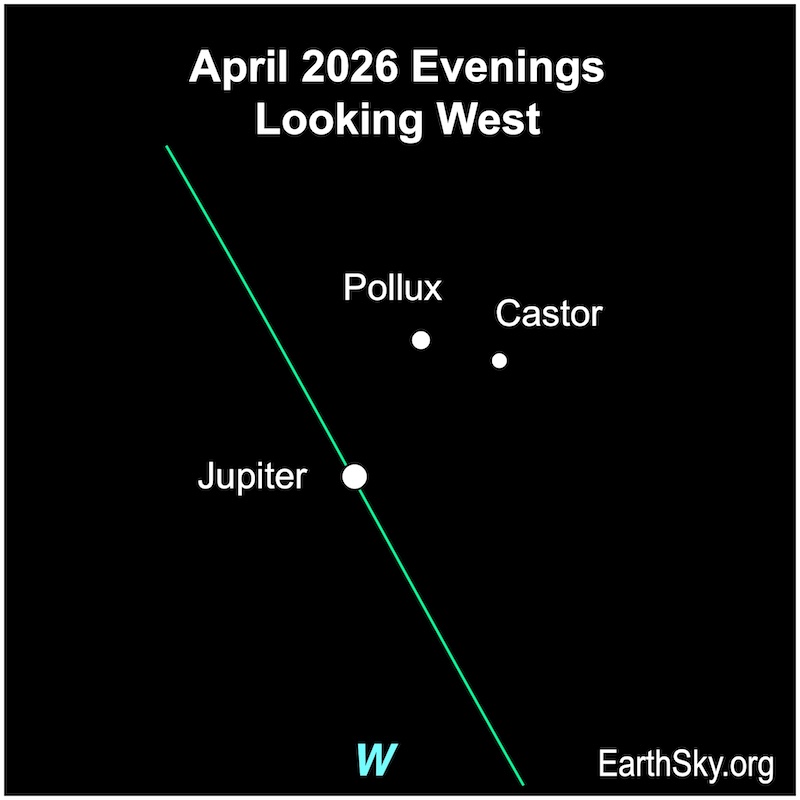
As darkness falls, Jupiter will shine brightly high in the sky. And it’ll be near the twin stars of Gemini, Castor (the slightly dimmer one) and Pollux (the slightly brighter one). The moon and Jupiter make a lovely pair on April 22. Jupiter will set about 3 hours after midnight on April 1. And it’ll set about an hour after midnight by month’s end. Chart via EarthSky.
April Morning Planets
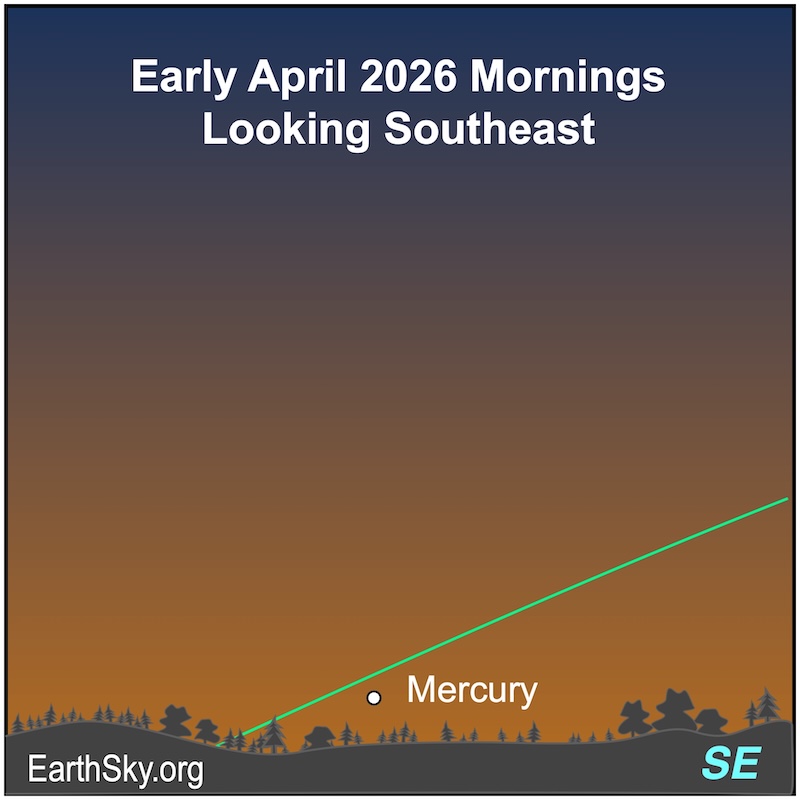
In early April, for the Northern Hemisphere, Mercury will lie very low above the eastern horizon shortly before sunrise. The twilight will compete with and may hinder your ability to spot the little planet. Observers in the Southern Hemisphere will have a better view of Mercury this month. And on April 3, 2026, Mercury will reach greatest elongation – when Mercury is farthest from the sunrise (28 degrees) – on our sky’s dome. Chart via EarthSky.
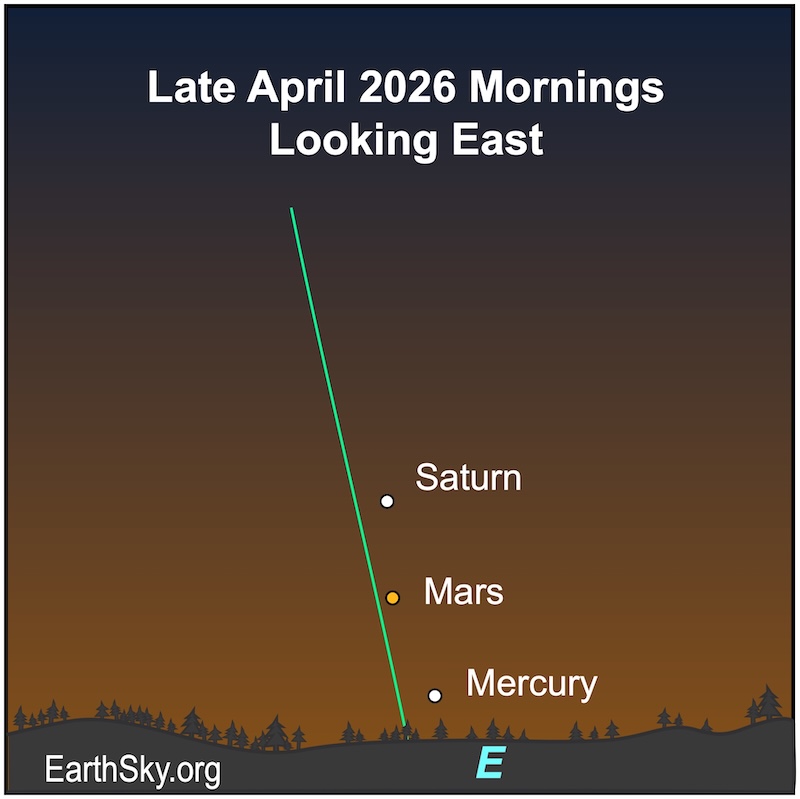
By late April, for the Southern Hemisphere, Mercury will lie close to the horizon shortly before sunrise and will slip away in early May. However, Saturn and Mars will be climbing higher each day, becoming more visible in the morning sky. Chart via EarthSky.
Sky Dome Map for Visible Planets and Night Sky
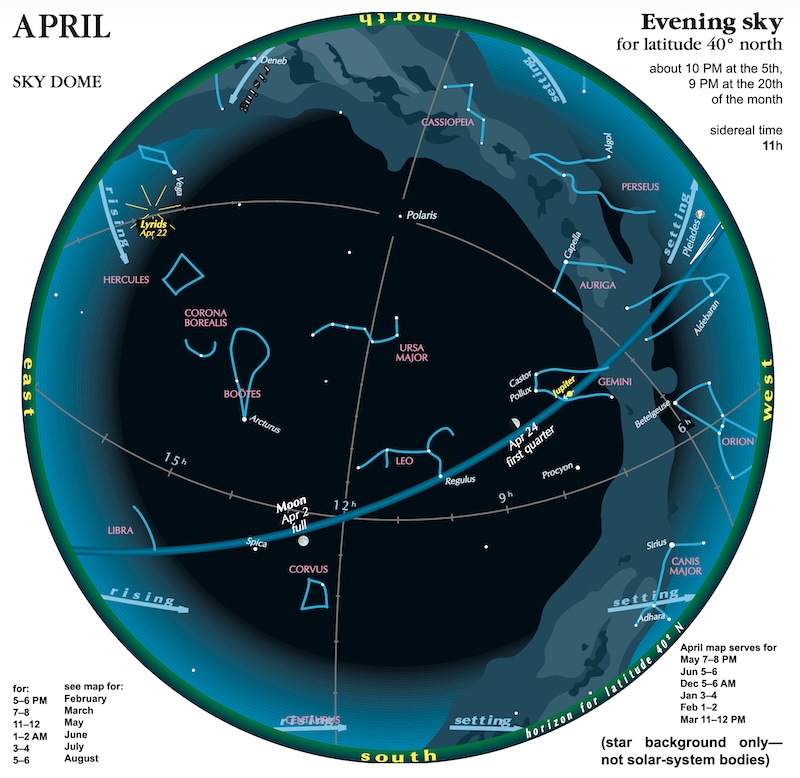
Here is the sky dome view for April 2026. It shows what is above the horizon at mid-evening for mid-northern latitudes. The view may vary depending on your location. Image via Guy Ottewell’s 2026 Astronomical Calendar.
Heliocentric Solar System: Visible Planets and More

Heliocentric view of solar system, April 2026. Chart via Guy Ottewell’s 2026 Astronomical Calendar. Used with permission. Heliocentric view of solar system, April 2026. Chart via Guy Ottewell’s 2026 Astronomical Calendar. Used with permission. Plus, Guy Ottewell explains heliocentric charts here.
Bottom line: Visible planets and night sky guide. Tonight, see the slightly bulging gibbous moon lying between bright Jupiter and the twin stars of Gemini. And don’t miss our video about the new sungrazing comet.
Originally published by EarthSky.