
Have you ever been to a double boom town called Sunshine in Garrett County, Maryland?
If you have driven through Crellin, Maryland, then you have.
Crellin first got its name from the Sunshine Council of the United American Mechanics. Second, it was called Lorawsville by some after its owner, W. A. Loraw, who purchased the mill in 1885. In 1892, it was changed to Crellin by the Federal Post Office Department in honor of its founder,r Rolland P. Crellin.
Crellin, Maryland, is a former double boom town located in western Garrett County, about 1 mile from the West Virginia border. Boomtowns, by definition, ion are communities that start from scratch and rapidly grow due to a sudden influx of wealth or opportunity, like the discovery of valuable resources, such as coal and timber.
While the town along Snowy Creek and the Youghiogheny River survives today, almost all physical traces of the area’s colossal logging, mining, and railroad empires have been lost to time. The town today has several churches,
an elementary school, Henline Auction House, which was the old company store, and a community that is invested in this quaint small town.
The sunshine that is currently present in Crellin today is a 4-star elementary school. Crellin Elementary School is under the leadership of Dr. Dana McCauley. She functions as a teacher as well as the principal, spending part of every day teaching students and devoting the remainder to administrative tasks. The school grounds have their own environmental laboratory and Sunshine Farm, which got its name because Sunshine was the original name of the town of Crellin, and began in 2011. The former county-owned grounds behind Crellin School contained a former
coal mine, and the water in the creek was orange from the polluted run-off.
Dr. Dana McCauley encouraged parents in the community to petition for the property, which now belongs to the school. An association of students, teachers, community members, nonprofits, and state and federal agencies worked on a restoration project to rid the creek of the acid run-off. Students also engage in learning opportunities in the Hemlock Forest, raise trout to repopulate the stream, and spend a great deal of time in the outdoor classrooms. There are goats, sheep, and chickens to take care of as well. The students are responsible for cleaning the barn and feeding the animals. They also gather and sell the eggs, and clean and sell the sheared wool from the lambs. A hydroponics system has also been started in the greenhouse. The students, parents, and community are invested in this little jewel of a school.
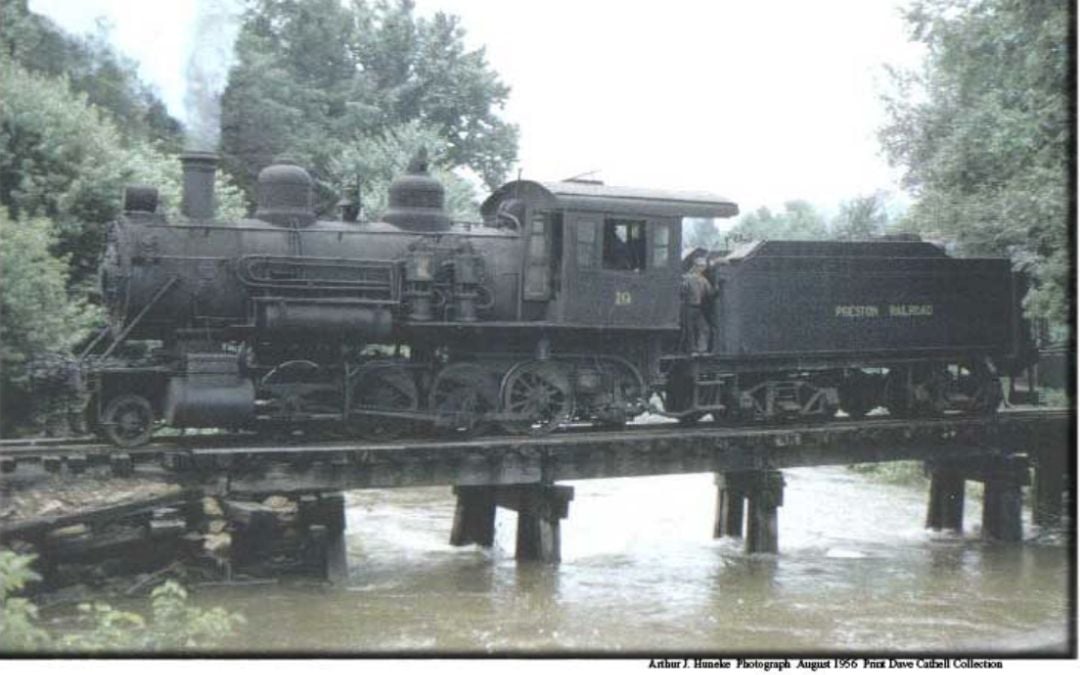
The Preston Lumber & Coal Company operated the Preston Railroad in Garrett County, which began operations in 1891 and served the company mill at Crellin, where an interchange was also located with the Baltimore & Ohio
Railroad. The Preston Railroad was used heavily to haul timber and coal out of the local mines to regional markets.
In 1906 it became part of the Kendall Lumber Company, which continued to operate it as the Preston Railroad. At
its peak, the Preston operated into West Virginia.
The last slab at the lumber mill was turned down by the famous old-young man Jesse Loraw, who was the son of
the original owner of a portable sawmill that stood in Crellin in 1890. He turned down the first and last slab on the old
mill as well as the first and last slab on the collection of Benjamin Kline the collection of Benjamin Kline the last mill, in 1925.
The Preston Lumber and Coal Company controlled 30,000 acres of timber land extending from the town of Crellin, south a distance of 20 miles and west three miles to the West Virginia line. This land consisted of virgin forests and was undermined with high-grade coal. This timber consisted of white oak, chestnut, hemlock, red oak, white pine, spruce, and sugar maple. To get an idea of the virgin forest,t take a trip to Swallow Falls in Maryland or Cathedral Park in nearby Aurora, West Virginia.
The mines near Crellin provided employment for the town’s residents for 40 years, but they were worked out by 1956 when they were closed.
The Crellin Historic District is significant as a well-preserved example of a company town which served the lumber, railroad, and coal industries in the late 19th and early 20th centuries. These industries were vital to the development of Garrett County during this period.
I am a third-generation coal miner’s daughter. My great-great-grandfather was a logger. As a native of Garrett County, I’m not sure if any of my ancestors worked the Crellin mines or walked the logs down to the Preston Lumber sawmill. It still makes me pause and think of the hard manual labor these men did to provide for their families. There are many old coal towns in Garrett County. Some of which are only old foundations and overgrown roads, but once were filled with the busy activity of working families, schools, company stores, post offices, and folks making a living along the rivers, in forests, underground in coal mines,s and on the railroads.
References: History of Crellin, Maryland: “Story of a Double Boom Town” by Robert C. Shaffer, 1976, Sincell Publishing Company. Glades Star, Issue #9, Vol. #2, page 145, June 30, 1952, “The History of Crellin”, by Ervel W. Ream
Written by Robin Clutter.
From the September issue of the Lakefront Magazine.